Codify Sustainability-Linked Sovereign Lending, Then Give It Scale
Standard indicators, verification and pricing, and why the reward must be bigger than an interest margin
Sustainability-linked debt lowers a government’s interest rate when it meets agreed climate targets, but it remains rare, bespoke and small: Uruguay’s 2023 World Bank loan, the first of its kind, can save the country at most $12.5 million. This brief proposes codifying the instrument, with standard indicators, verification from published data and a published price per tonne. The reward should come from outside, through an intermediary, because a bond whose coupon moves with results makes the government pay for its own reward. Even then an interest margin is too small to pay for major reforms. Guarantee capacity as the reward gives it scale.
sustainability-linked loans, sustainability-linked bonds, sovereign debt, climate incentives, guarantees, key performance indicators
Climate Fiscal Policy Brief No. 4.3, October 2026. Stephen J. Stretton, writing in a personal capacity. The views expressed are the author’s own and do not represent those of any institution with which he is or has been affiliated. The design that pays the reward through an intermediary comes from joint work with Marcello Estevão and Nils Zimmermann (Estevão et al. 2024). The full analysis, with the model, proofs and calibration, is in the working paper.
Key messages
Read the full working paper → · Download this brief (pdf) · Slides (pdf)
Sustainability-linked debt pays governments for national climate results, but each deal is handmade and small. Uruguay’s $350 million World Bank loan, the first sovereign loan of its kind, can save the country at most $12.5 million.
Codify it. Publish a menu of indicators that national statistics already report, baselines set at each country’s own Paris pledge plus a margin, verification by a named verifier and a price per tonne of CO₂.
Pay the reward from outside. When a bond’s coupon moves with results, investors charge for the expected step when they buy, so the government pays for its own reward. An intermediary that lends on a fixed coupon and refunds interest for verified results brings outside money.
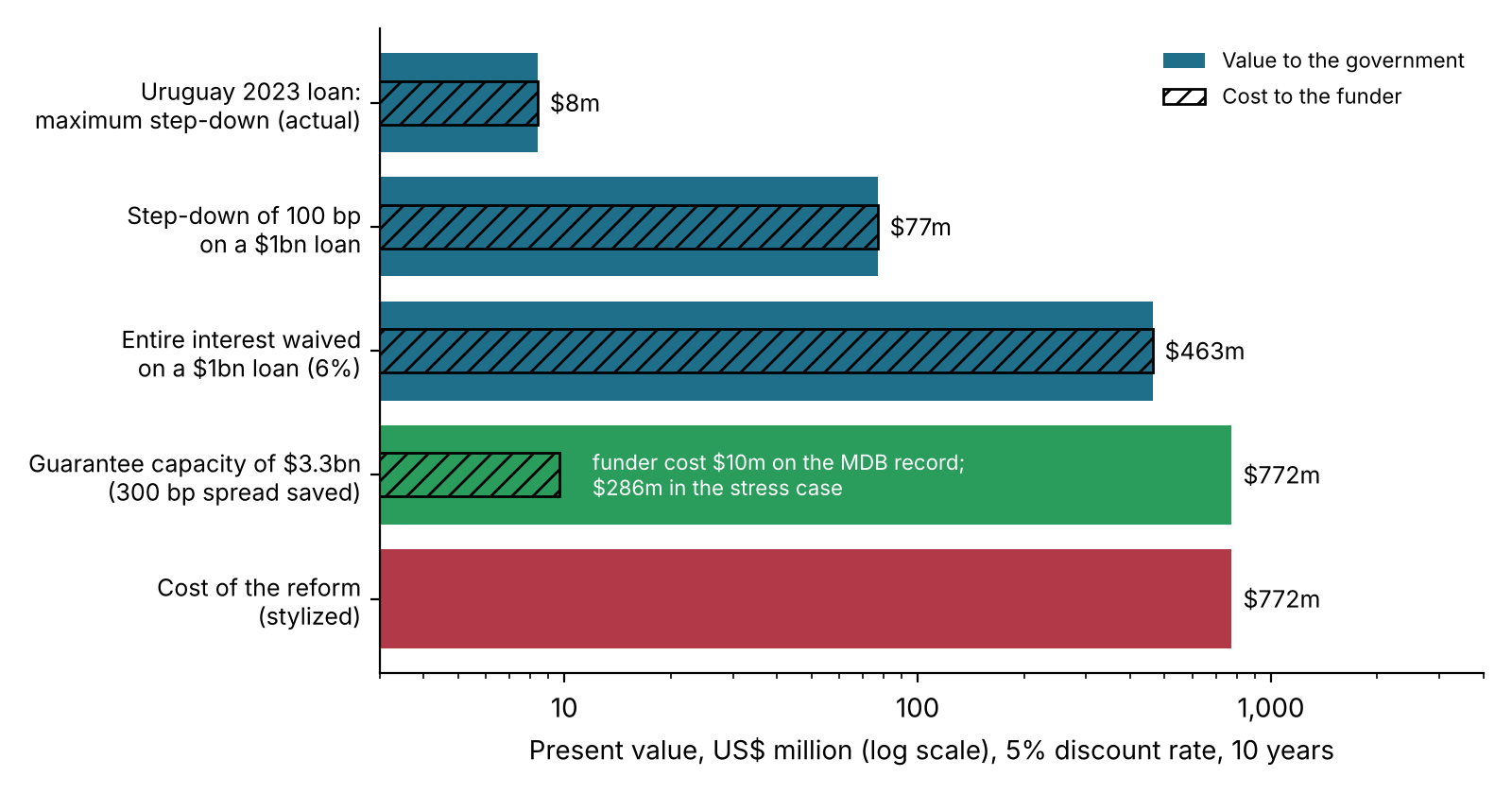
An interest margin is too small. A 100 basis point step-down on $1 billion is worth $77 million over ten years, against $772 million for a stylized coal reform.
Make guarantee capacity the prize. $3.3 billion of capacity is worth $772 million to the government and costs the funder about $10 million on development banks’ loss record, or $286 million on market-like losses.
Sustainability-linked sovereign debt exists, and it is small
Sustainability-linked debt pays a government for results, not for projects. A green bond finances a named solar park. A sustainability-linked bond or loan leaves the money unrestricted and changes its price according to key performance indicators: measured national outturns such as emissions per unit of output or the area of native forest. That makes it one of the few instruments that rewards national policy, which is where the large emission cuts lie.
A handful of governments have used it since 2022, each in its own way. Chile issued the first sovereign sustainability-linked bond in March 2022: $2 billion over 20 years, with a coupon step-up of 12.5 basis points for each of two missed targets from 2034 (Cleary Gottlieb 2022). Uruguay followed in October 2022 with the first step-down as well: its coupon rises 15 basis points for each lower target it misses and falls 15 for each higher target it meets, on emissions intensity and native forest area (Oriental Republic of Uruguay 2023). Thailand sold Bt30 billion (about $874 million) in November 2024 with steps of 2.5 basis points (IFR 2024), and Slovenia €1 billion in June 2025 with steps of 50 (Republic of Slovenia 2025).
Uruguay’s World Bank loan is the clearest model. Approved in November 2023, the $350 million loan’s rate falls by 50 basis points a year in 2028–2032 if the methane intensity of beef cattle is at least 33 percent below 1990, one point beyond Uruguay’s first Paris pledge, and by 100 basis points in 2033–2037 at 36 percent, one point beyond its second. There is no penalty for missing. The United Nations Development Programme verifies the national inventory, and a World Bank fund for global public goods pays the reward (Ministry of Economy and Finance, Uruguay 2023; World Bank 2023).
The rewards are tiny next to the cost of policy. Uruguay’s reward is capped at $12.5 million, 3.6 percent of the loan and about $8 million in present value (working paper, Uruguay). South Africa’s transition plan alone identifies $98 billion of financing needs over five years (UK Government 2022).
Why it does not scale
Every deal is bespoke. Each issuer picks its own indicators, baselines and step size, and pays lawyers, verifiers and reviewers to defend them. The market’s voluntary standard, the International Capital Market Association’s Sustainability-Linked Bond Principles, sets out how to disclose these choices, not what they should be (International Capital Market Association 2024). The usual step of 25 basis points is, in World Bank staff’s words, “the arbitrary market norm” (Stewart and Ul Haq 2023; Climate Bonds Initiative 2024).
Targets are easy. Corporate issuers miss their targets only 14–39 percent of the time (Feldhütter et al. 2024). A reward paid whatever the government does changes nothing; only the extra chance of meeting the target because of the policy counts (working paper, minimum reward).
Rewards arrive late. Emissions data take years to compile and verify. Uruguay’s methane result for 2025 is verified only in 2028, and the last reward is applied in 2037, fourteen years after the loan was approved (Ministry of Economy and Finance, Uruguay 2023). A finance minister heavily discounts a reward paid to a successor.
A bond whose coupon moves with results gives the government no money. Investors who can see the target charge for the expected step when they buy the bond; studies find bond prices track the size of the penalty, with no mispricing (Feldhütter et al. 2024; Lefournier 2023). Once the bond is sold the government still gains from meeting the target, so the bond is a commitment device, but the government has paid for its own reward and a premium for the uncertainty. That cannot pay for a reform that costs the country more than it gains, which is the case for most mitigation. Uruguay’s bond can lower its coupon by up to about $40 million in total, three times the loan’s reward, but bondholders priced that in (working paper, who pays).
Codify: indicators, baselines, verification and a price
A codified instrument is a contract written once and used many times. Each new loan then chooses only which indicators apply and how much debt is linked. The World Bank Group’s own reform roadmap already proposes “standardized approaches” to interest buy-downs and performance-based incentives (World Bank Group 2022).
Indicators should be outturns that national statistics already report. “Methane per kilogram of beef” is an outturn; “methane strategy adopted” is a process step. Outturns are hard to meet on paper, leave the government free to choose the cheapest policy, and convert to tonnes. The working paper gives a starter menu of eleven indicators in six sectors (working paper, indicator menu), most already used in a sovereign deal.
Baselines should be set by rule. Uruguay’s rule is worth copying: the target is the country’s own unconditional Paris pledge plus a fixed margin, so the government cannot negotiate a soft baseline (Ministry of Economy and Finance, Uruguay 2023). A peer-based floor protects against weak pledges.
Verification should check the national inventory, not commission new surveys. Uruguay’s verifier reviews the same inventory the country reports under the Paris Agreement, smoothed over five years to remove weather noise (Ministry of Economy and Finance, Uruguay 2023). One verifier and one method per indicator class turns verification into a routine service.
The reward per unit of outperformance should be published and stated per tonne. The reward for one point of an indicator equals the tonnes that point implies times a notional carbon price. That lets a funder compare a forest indicator in one country with a power indicator in another, and puts sustainability-linked lending on the same scale as policy crediting, the payment per tonne cut by a policy (Brief 1.1; Brief 6.1).
Pay the reward from outside
Investors should hold a fixed coupon, and a public partner should pay the reward. In the design developed with Marcello Estevão and Nils Zimmermann, a trusted intermediary backed by guarantees from a coalition of advanced economies issues fixed-coupon bonds at a low rate and lends the money to governments as sustainability-linked loans at a somewhat higher fixed rate (Estevão et al. 2024). When verified indicators are met, it refunds part of the interest already paid. Development agencies monitor the indicators and give technical help.
The government gets money from outside, and the risk lands where it is cheapest to bear. A pension fund charges a premium to hold a coupon that moves with a country’s methane statistics. An intermediary lending to many countries diversifies that risk and can bear it near cost (working paper, Proposition 2).
A missed target should cost the government its refund, not pay bondholders a premium. A step-up hands money to investors who did nothing to earn it and does nothing to put the country back on track.
The size problem
Even a well-designed sustainability-linked loan pays too little to change a large policy. A rebate cannot exceed the interest bill. Table 1 compares rewards with a stylized reform that retires 2 gigawatts of coal ten years early, avoiding 11.4 million tonnes of CO₂ a year at a net cost of $100 million a year: $772 million in present value.
| Reward | Value to government ($m) | Cost to funder ($m) | Incentive per $ of cost |
|---|---|---|---|
| Uruguay loan, maximum step-down (actual) | 8 | 8 | 1 |
| 100 bp step-down on $1bn for 10 years | 77 | 77 | 1 |
| All interest waived on $1bn at 6% for 10 years | 463 | 463 | 1 |
| $3.3bn of guarantee capacity, 300 bp saved: development banks’ loss record | 772 | 10 | 80 |
| Same, market-like losses (stress case) | 772 | 286 | 2.7 |
| Stylized reform cost | 772 |
A 100 basis point step-down on $1 billion is worth $77 million, under $1 per tonne avoided. Matching the reform’s cost at that step needs a $10 billion loan, nearly thirty times Uruguay’s.
Even waiving all interest falls short. At 6 percent, waiving every dollar of interest on $1 billion for ten years is worth $463 million. The loan would need to exceed $1.7 billion and carry no interest at all (working paper, the interest bound).
Give it scale: make guarantee capacity the reward
A guarantee delivers a large incentive at a small cost. The borrower values it at the whole spread it saves, while the guarantor pays only its expected loss and the cost of holding a buffer. Meeting the indicators should earn guarantee capacity: the maximum outstanding guarantee exposure that multilateral development banks will provide on the country’s eligible green borrowing. Under the notional capitalized value of Brief 4.1, meeting indicators adds to that capacity (Stretton 2026d); under the Climate Investment Trust of Brief 4.2, it credits the country’s beneficiary account, which it can pledge as collateral now (Stretton 2026e).
In the stylized reform, $3.3 billion of capacity pays for the reform. On borrowing that saves 300 basis points it is worth $772 million to the government. If the guarantor’s losses match development banks’ record on their own sovereign loans, the base case shared with Briefs 4.1 and 4.2, its expected cost is about $10 million and a $16 million buffer is held, not spent: about 80 dollars of incentive per dollar of cost (working paper, the coal reform).
The multiple is lower if governments treat the guarantor like a market creditor. Development banks’ record reflects their status as preferred creditors, which governments keep paying even in a crisis. If a new guarantor’s claims are treated like market debt, its losses look like the stress case: an expected cost of $286 million with a $310 million buffer, 2.7 dollars of incentive per dollar, still better than cash. At a 200 basis point saving, the multiples are 53 and 1.8. A new facility should price on the record but hold the stress-case buffer until it has its own; if that buffer costs 2 percent a year to hold, the multiple on the record falls to about 13 (working paper, the strongest objection).
The government’s exposure does not disappear. It becomes smaller, contingent and contracted, because a called guarantee is a debt the country owes back to the guarantor (Brief 3.1). And guarantee capacity is worth most to a government that will actually borrow for clean investment.
The two routes fit in one contract. The sustainability-linked loan supplies the indicator, the baseline, verification and the price; the guarantee supplies the size. One verification can trigger both the refund and the extra capacity. Kenya’s planned sustainability-linked loan, reported in July 2026 to carry a World Bank credit enhancement, would be a first step toward combining the two (Muiruri 2026).
What to do
Multilateral development banks: publish a codified sovereign sustainability-linked loan. It should contain an indicator menu, baselines at each country’s Paris pledge plus a published margin, verification rules based on national inventories, and a price per tonne. Offer step-downs on that schedule, as the World Bank did for Uruguay, without negotiating each deal from scratch.
Advanced economies: back an intermediary that lends on a fixed coupon and refunds interest for verified results. Investors then hold a plain asset and the incentive sits with a public partner. Do not count market bonds with moving coupons as climate finance for the borrower: they buy commitment, not reform.
Donors: make guarantee capacity, not the interest rebate, the main prize, and fund the buffer behind it. The rebate is the signal; the guarantee is the incentive. Every reward must be additional to the country’s existing concessional finance, or it pays nothing.