From Projects to Asset Classes
Two-Stage Finance and Synthetic Sovereign Bonds for Clean Power
Clean power plants in developing countries are financed one at a time, on bespoke terms, so each lender prices construction, payment, currency and sovereign risk together for the life of the loan. This brief proposes turning them into a few standard securities. Banks finance construction against a contingent purchase contract; once plants operate, their debt is refinanced into pools that issue first-loss equity, a thin mezzanine and a senior synthetic sovereign bond. Pooling across countries under one contract keeps the cushion thin, and refinancing cuts the price of solar power by about a fifth. Standardization, not subsidy, lowers the price.
renewable energy finance, securitization, first-loss capital, guarantees, cost of capital
Climate Fiscal Policy Brief No. 3.2, October 2026. Stephen J. Stretton, writing in a personal capacity. The views expressed are the author’s own and do not represent those of any institution with which he is or has been affiliated. The two-stage finance and tiered guarantee material was developed with Jasper Zimmermann. The full analysis, with the model, proofs and robustness checks, is in the working paper.
Key messages
Read the full working paper → · Download this brief (pdf) · Slides (pdf)
Bespoke finance is expensive finance. Solar power is mostly the cost of the money that built it, and that money is dear partly because each plant is financed alone, on bespoke terms.
Split each project at commissioning. Banks finance the two-year build; once the plant runs, bond investors refinance its debt.
Pool and tranche operating plants under one standard contract. A thin first-loss layer and a mezzanine let 70 to 92 percent of the debt come from a highly rated senior “synthetic sovereign bond”.
The saving is about a fifth of the price of solar power. It is still 14 percent with the thick cushions real deals carry.
Pool across countries, publish the numbers, and keep the host’s exposure on the books. Ten-country pools need about 40 percent less cushion; the host’s guarantees remain contingent liabilities.
Bespoke finance is expensive finance
The cost of capital, not the cost of panels, now sets the price of clean power in developing countries. For a stylized solar plant costing $800 per kilowatt with a 20 percent capacity factor, power costs 3.6 US cents per kilowatt-hour at a 4 percent cost of capital and 6.5 cents at 12 percent. At 10 percent, financing is 56 percent of the price (working paper, calibration). The International Energy Agency’s survey of financiers found that the cost of capital for utility-scale solar in emerging and developing economies is well over twice that in advanced economies, and that financing can be around half or more of the cost of their solar power (International Energy Agency 2024).
Removing the risk that the buyer will not pay is the first step. The companion brief proposes a payment intermediary that buys power under one standard contract and pays generators in full and on time whatever the state-owned distribution company does, backed by a waterfall of guarantors agreed in advance (Brief 3.1).
A guaranteed contract is not yet cheap money. Each project is still financed alone, by a lender who prices the host government into every coupon and cannot sell the loan, because nobody will rate plants one at a time. Deal-by-deal blended finance mobilized only $0.75 of private money per dollar of development finance across developing countries in 2012–2015, and $0.37 in low-income countries (Attridge and Engen 2019). Pension funds and insurers have the money; what they lack is a standard, rated security they are allowed to buy (Ehlers 2014; Arezki et al. 2017).
Split each project at commissioning
A plant under construction and a plant in operation are different credits. Construction lasts about two years and needs supervision; operation lasts twenty-five, with predictable output and no fuel. Moody’s data on 6,389 project finance loans show default rates like those of speculative-grade borrowers in the first three years, falling toward single-A levels by year seven; loans that survived their first three years defaulted at under 3 percent over the next seven, and lenders recovered 80 percent on average (Moody’s Investors Service 2017).
Two-stage finance gives each phase to the investor who prices it most cheaply. Banks and development finance institutions, which can supervise construction, lend for the build; bond investors, who want long, safe cash flows, refinance the operating plant’s debt. Single-stage finance carries the construction-era price of risk through all twenty-five years of operation.
The rate on the long phase is what matters. Because operation lasts more than ten times as long as construction, a percentage point off the operating cost of capital lowers the price of power about nine to eleven times as much as a point off the construction rate (working paper, the refinancing gain).
A contingent purchase contract ties the two stages together. Before construction, the payment intermediary commits to buy the plant’s power on completion under its standard contract. The construction lender then lends against a creditworthy buyer, and the pool knows exactly what it will be offered. Developers can bid a tariff on the refinanced cost only if refinancing is assured; otherwise they add a premium for the risk that it will not come.
Pool the operating plants and tranche the pool
Operating plants’ debt is pooled and refinanced through three securities, each for a different investor. A first-loss tranche of equity absorbs losses before any debt does; its natural holder is a regional fund of the Climate Investment Trust (Brief 4.2). A thin mezzanine sits above it, held by development lenders or insurers, or replaced by a guarantee from highly rated sovereigns. The senior synthetic sovereign bond, backed by guaranteed contracts on operating plants, the cushion beneath it and that co-guarantee, is rated on the structure rather than on the host government, and is sold to pension funds and insurers.
In a large pool of operating plants, a cushion of 5 to 8 percent makes the senior bond near-AAA. A standard portfolio model, the one behind the Basel bank capital rules, sizes the cushion from three numbers: how often operating plants default, how much is lost when they do, and how much they fail together. With a 5 percent chance of default over ten years and 80 percent recovery, a near-AAA senior bond needs 4.8 percent of losses absorbed beneath it if plants fail together a little (a correlation of 0.10) and 7.7 percent if they fail together more (0.20). Halving recovery doubles the cushion (working paper, how much first loss).
The host government is the main reason plants fail together, and pooling across countries removes it. Plants in one country share a currency, a regulator, a distribution sector and a treasury, so a sovereign crisis hits them all at once. In the working paper’s illustration, a near-AAA bond on a single-country pool needs 9.1 percent subordination; on a pool spread over ten countries, 5.3 percent. That gain is available only if the plants carry the same contract: identical contracts make portfolios, and portfolios make ratings.
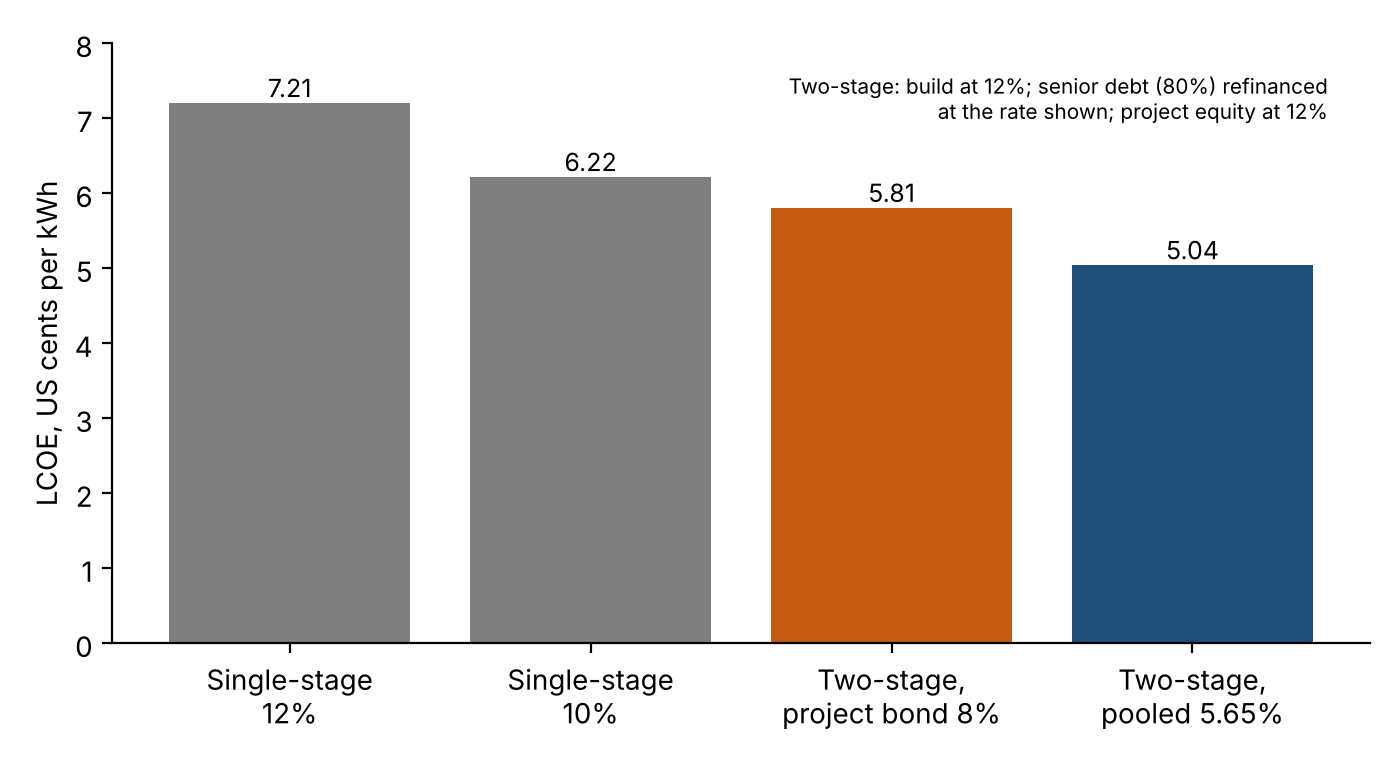
What it saves: about a fifth of the price of power
Refinancing into a tranched pool cuts the cost of solar power from 6.2 to 5.0 cents per kilowatt-hour. Table 1 compares ways of financing the stylized plant, including interest during a two-year build. Against single-stage finance at 10 percent, building at 12 percent and refinancing the senior debt into a stand-alone project bond at 8 percent saves 7 percent. Refinancing it into the pool, whose blended cost is 5.65 percent with stylized returns of 12 percent on first loss, 8 percent on mezzanine and 5 percent on the senior bond, saves 19 percent. The sponsor’s equity, a fifth of the plant’s cost, still earns 12 percent.
| How the plant is financed | Cost of the operating plant’s money | Cost of power (US c/kWh) | Change |
|---|---|---|---|
| Single-stage at 10% | 10.0% | 6.2 | — |
| Two-stage, debt refinanced into a project bond at 8% | 8.8% | 5.8 | −7% |
| Two-stage, debt refinanced into a pool at 5.65% | 6.9% | 5.0 | −19% |
| Two-stage, pool with a 30% cushion (as in real deals) | 7.7% | 5.3 | −14% |
| Two-stage, pool in lower-middle-income stress case | 7.25% | 5.2 | −17% |
The saving survives the strongest objection: real deals carry much thicker cushions. The first securitization of Asian infrastructure loans, Clifford Capital’s Bayfront deal of 2018, put 30 percent of the notes beneath its most senior class (Allen & Gledhill 2018). Its pool was small (37 loans), mixed sectors and included plants still under construction, and agencies had no record to rely on. With the same 30 percent cushion, the saving is still 14 percent, because the senior bond still funds most of the pool cheaply (working paper, robustness). The 5 to 8 percent cushion is where a large, standard pool with a track record ends up, not where the first issue starts.
A sovereign co-guarantee of the mezzanine is cheap in expectation and expensive in a crisis. On a $10 billion pool it covers $460 million at an expected cost of about $6 million over ten years, but all $460 million can be drawn in a regional crisis.
Where there is no contract, guarantee the bond
Transmission lines and storage have no power contract to guarantee, and without them cheap generation buys nothing. Vietnam added 16.5 gigawatts of solar in 2019–2020, mostly in southern provinces with a weak grid, and curtailed about 364 gigawatt-hours of solar output in 2020 (Ketelsen et al. 2023). South Africa’s 2022 auction sought 3,200 megawatts of wind and awarded none, because the grid in the Eastern and Western Cape, where every wind bid was, had no room (Bellini 2022).
The first choice is to create a contract. Privately financed transmission lines, tendered and paid on availability, raised more than $24.5 billion of investment in Brazil, Chile, Peru and India in 1998–2015 (World Bank 2017). A contracted line can enter the pool like a solar plant. The rule is simple: guarantee the contract where there is one, and guarantee the bond where there is not.
For backbone lines and storage that cannot be contracted, a tiered bond guarantee does the job, conditional on reform. Behind the bonds stand the government that regulates the power system, then the national government, then a donor-backed vehicle. Guarantees go only to governments that adopt agreed reforms: the standard power purchase agreement, cost-reflective tariffs, a coal retirement schedule and workable grid connection. Because a state and its national government often fail together, the donor tier carries more than it seems: in a stylized example, raising the correlation between tiers from zero to 0.5 triples the chance that the donor is called, from 1.2 to 3.6 percent over ten years (working paper, tiered guarantees).
Local currency for domestic savers
A dollar senior bond moves currency risk to the host; a local-currency senior tranche keeps it out. Where power contracts are in local currency, the pool can issue the same senior claim in local currency, with the same cushion beneath it, for domestic pension funds, insurers and banks. Banks can sell it as a fixed-term green savings certificate. A local-currency pool cannot diversify across countries, so it needs a thicker cushion or a local-currency guarantor such as GuarantCo, rated A1 by Moody’s and AA− by Fitch (Private Infrastructure Development Group 2025).
The host government’s exposure shrinks but does not vanish. The national government stands in the guarantee waterfall behind the intermediary and in the second tier of grid guarantees. These are contingent liabilities, mostly triggered only if the government’s own utility stops paying or its own policy reverses. They should be recorded and capped, not denied.
What to do
Payment intermediaries should write a contingent power purchase agreement and a published refinancing route into every auction, so that developers bid on the refinanced cost of capital.
Development banks should sponsor regional pools of operating clean power plants under one standard contract, size the first loss with a published model at the cautious end of plausible correlation and recovery, and expect the first issues to carry thick cushions that thin as a record builds. Keep each pool to one asset type, with no re-securitization.
The Climate Investment Trust’s regional funds should hold the first-loss tranches, priced explicitly and published, with the right to sell seasoned positions so the capital recycles (Brief 4.2).
Highly rated sovereigns should co-guarantee the mezzanine layer rather than fund it, and hold explicit reserves against the correlated tail.
Host governments should contract transmission and storage where they can, and seek tiered bond guarantees, conditional on reform, where they cannot. They should record their contingent liabilities under these structures and cap them.
Central banks and financial regulators should treat the local-currency senior tranche as a high-grade asset for domestic pension funds, insurers and banks, with capital treatment that matches its structure.