The Climate Investment Trust: Hold Capital, Lend Its Strength
A buffer fund that insures policy guarantees, invests in clean energy and holds national climate accounts
International rewards for national climate policy fail because donors will not vote for large cash transfers and governments cannot borrow against promises. This brief proposes a Climate Investment Trust that holds capital instead of spending it. One pool stands second behind the guarantees that reward policy, earns fees by co-investing in clean energy, and holds national accounts that countries pledge as collateral now and draw after 2050. On the development banks’ sovereign loss record, each donor dollar delivers about 80 dollars of interest savings; without their preferred-creditor status, 2.7. Holding the cautious buffer, the Trust grows on its own yield if losses follow the banks’ record.
climate finance, guarantees, trust funds, sovereign incentives, multilateral development banks, buffer capital
Climate Fiscal Policy Brief No. 4.2, October 2026. Stephen J. Stretton, writing in a personal capacity. The views expressed are the author’s own and do not represent those of any institution with which he is or has been affiliated. The regional fund design draws on joint work on two-stage clean energy finance with Jasper Zimmermann. The full analysis, with the model, proofs and calibration, is in the working paper.
Key messages
Read the full working paper → · Download this brief (pdf) · Slides (pdf)
Climate money spent once buys little policy. Cash rewards on the needed scale will not be voted, and governments cannot borrow against promised payments.
Hold the money instead, behind guarantees. A Climate Investment Trust stands second behind the guarantees that reward climate policy: the government first, the Trust second, a AAA-rated backer last. A guarantee saves the borrower the whole spread but costs only the expected loss.
On the development banks’ record, each donor dollar delivers about 80 dollars of interest savings; without their preferred-creditor status, 2.7. Holding the cautious buffer costs much of the gain until the Trust has its own record.
Accounts for future generations make the reward stick. Each country’s account grows when it acts and shrinks when it retreats, can be pledged now and is drawn after 2050; a feebate between accounts costs nothing net.
Launch it as insurance first. Publish the rules, book the Trust’s claims through a development bank, and add investment later.
Climate money is spent once
The reward for national climate policy has to come from outside, and cash on the needed scale will not come. Cutting emissions pays off for the world; the cost falls on the government that cuts. Fossil carbon dioxide emissions were about 37.8 billion tonnes in 2024 (Friedlingstein et al. 2026). Paying $100 a tonne for a 10 percent cut would cost about $380 billion a year, and paying against negotiated baselines rewards countries that wait. Even modest pooled funds are hard to raise: the Tropical Forest Forever Facility launched in November 2025 with $6.7 billion of pledges against a $25 billion target for its sponsor capital (Barber et al. 2025).
Guarantees deliver a large reward cheaply, if someone holds the capital behind them. A guarantee from a AAA-rated institution saves a government the whole credit spread on its borrowing, perhaps 3 percentage points a year, but costs the guarantor only the losses it expects, a few hundredths of a percent a year on the development banks’ record. The Trust holds the capital that absorbs those losses.
A trust separates who pays, who decides and who benefits
Donors fund the Climate Investment Trust and hold its votes, a development bank manages it, and the beneficiaries are future generations. The formal beneficiaries are the post-2050 populations of participating countries, each through a national beneficiary account. A global account holds what no country has yet earned and meets the first guarantee calls.
Countries benefit long before 2050, because an account is an asset. A balance that cannot yet be drawn can still be pledged as collateral, which lowers the rate a country pays on green borrowing.
A deduction from an account can be enforced where a charge on a sovereign cannot. The Trust credits accounts for policy kept and deducts for policy reversed. A payment to a government can be reversed by the next government; an account held for the country’s future population, which grows when it acts and shrinks when it retreats, builds a constituency for persistence (Stretton 2026g).
One pool does three jobs
First, the Trust stands second behind policy guarantees. A government that commits to a policy, such as annual auctions of guaranteed-price contracts for clean power, gives a guarantee. It takes first loss by indemnifying the guarantor, as under existing multilateral guarantees; the Trust pays if it does not, and recovers over time; a development bank or highly rated sovereign stands behind the Trust and is touched only if the buffer runs out. This is the buffer behind the guarantee capacity of Brief 4.1, in which a country’s notional capitalized value caps the guarantees development banks provide on its green borrowing (Stretton 2026e).
Second, the Trust and its regional funds invest, with the buffer kept apart. Through a separate investment function, the Trust co-invests with pension and sovereign wealth funds in clean energy before financial close and sells once plants are connected and refinanced. Private investors pay it a quarter of their returns and vote only on investment. Regional funds set up with regional development banks hold the first-loss tranche of pools of operating plants, beneath the senior bonds of Brief 3.2, where a large pool needs a cushion of 5 to 8 percent and the first real deals carried about 30 (Stretton 2026c). The buffer itself stays in high-grade bonds, because clean power equity loses value in the same crises that trigger guarantee calls.
Third, the Trust credits its surplus to national accounts by performance. A base allocation rewards joining. A feebate between accounts rewards performance: accounts are credited for emissions intensity below the participants’ average and debited above it, so the transfers cancel and cost the Trust nothing (working paper, allocation rule). The same accounts can deliver the reward in sustainability-linked lending, as collateral or guarantee capacity rather than a few basis points (Brief 4.3).
Holding beats spending, on conditions that can be checked
A buffer supports exposure many times its own size because guarantee calls do not all come at once. The development banks’ sovereign loans defaulted at 0.77 percent a year over 1984–2024, and the banks recovered 95.1 percent of the amounts in default (European Investment Bank 2025). If the Trust stands behind 20 equal guaranteed programs with losses like that, and calls are moderately correlated, a buffer of 0.5 percent of exposure keeps the chance of exhausting it in any year to 1 percent. On paper, $5 billion could support about $1 trillion of guarantees (working paper, buffer and leverage).
Each donor dollar held delivers the spread saved divided by the Trust’s expected loss: about 80 on the banks’ record. A dollar paid out is gone. A dollar held is consumed only by losses, while the guarantees it supports save borrowers money every year. With a 3-point spread saving and expected losses of 0.038 percent a year, the ratio is about 80; a fund that pays out delivers one (Figure 1, panel A). This holds when the buffer earns what donors would earn elsewhere. If it earns 2 percent a year less, the ratio is 63.
The record belongs to the banks, so the Trust should not assume it. Governments in distress keep paying development banks because they treat them as preferred creditors, a practice that is informal, with no binding legal status (G20 Expert Panel on Multilateral Development Banks’ Capital Adequacy Frameworks 2022). A new trust standing behind market debt might not be treated so well. In a stress case, guarantees are called at 3 percent a year and the Trust loses 37 cents on each dollar called, the average creditor loss in sovereign restructurings over 1970–2010 (Cruces and Trebesch 2013). The buffer must then be 9.25 percent, $5 billion supports $54 billion of guarantees, and each dollar delivers 2.7. A middle case, with a 10 percent loss, gives 10.
Prudence has a price: holding the stress-case buffer cuts the reward to about 13 per dollar until the Trust has a record. A Trust that holds a 9.25 percent buffer while its losses follow the banks’ record supports $54 billion, not $1 trillion. The capital is safe, but it does little work: at a 2 percent carry each dollar delivers about 13. Building a record fast, with many small programs and every call and recovery published, is how the Trust earns the right to hold less.
A called guarantee needs cash before the money comes back. On the banks’ record almost everything called is recovered, but only later. If the buffer must pay a year’s debt service on each call itself, $5 billion supports about $390 billion rather than $1 trillion. A liquidity line from the AAA backer, repaid from recoveries, lets the buffer be sized for losses alone.
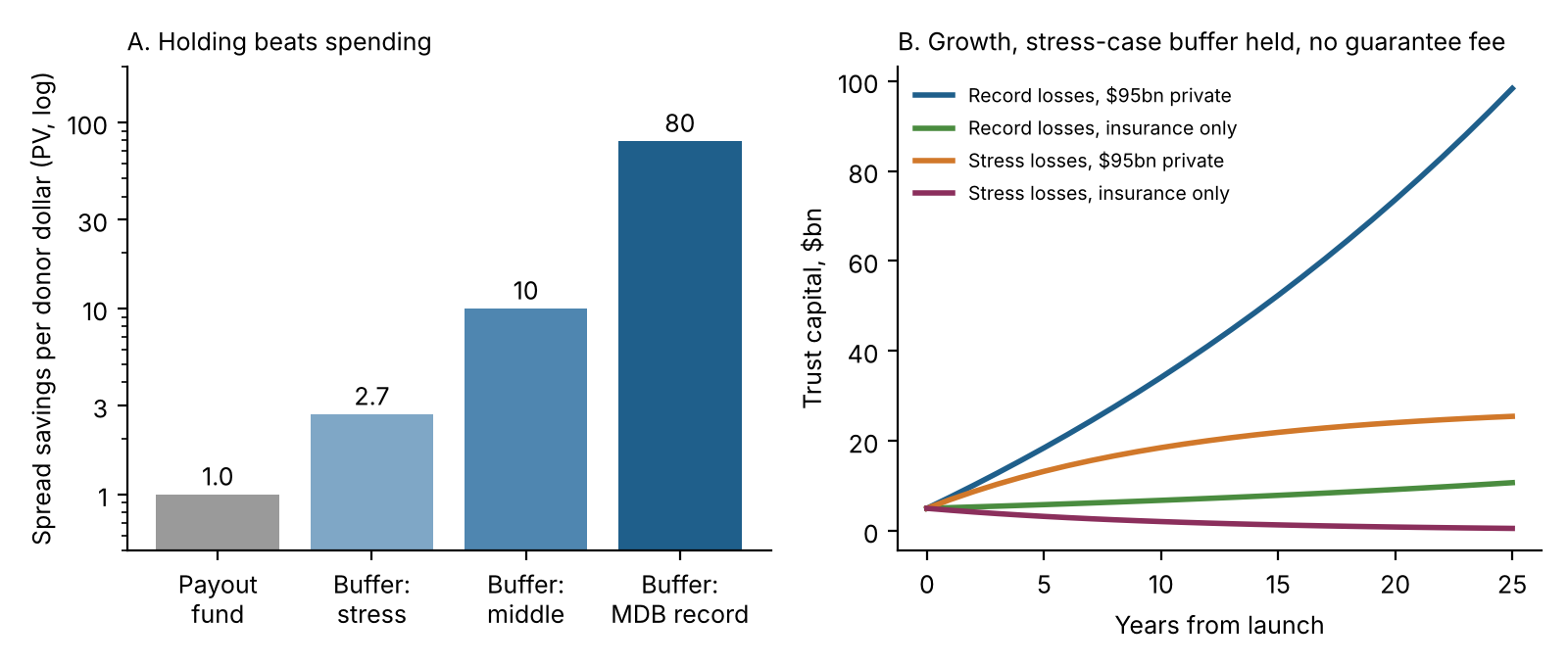
The loss record decides whether the Trust grows
A Trust that holds the stress-case buffer grows on its own yield if its losses follow the banks’ record. A 9.25 percent buffer earning 3.5 percent net of costs loses only 0.4 percent of its capital a year to expected calls at the banks’ loss rate. With no fee and no other income it grows by about 3 percent a year, to $10.7 billion after 25 years. If losses are at the stress level it shrinks by 8.5 percent a year, and holds steady only with a guarantee fee of about 0.8 percent of exposure, which still leaves the borrower 2.2 of its 3-point saving (working paper, growth).
Fees on private co-investment make it grow faster, but the private money is the least certain number. With $95 billion of private equity earning 10 percent and paying a 25 percent fee, the Trust earns $2.4 billion a year and reaches $34 billion after 10 years on the banks’ record, or levels off near $28 billion in the stress case. That sum of private equity, from the author’s earlier proposal, is an upper case: the closest working vehicle, Climate Investor One, raised $850 million for development and construction equity (FMO 2019). With $10 billion the Trust barely grows.
| Assumption or result | Banks’ record | Stress case | Basis |
|---|---|---|---|
| Expected loss on guarantees, % of exposure a year | 0.038 | 1.11 | Record: 0.77% calls × 4.9% loss (European Investment Bank 2025); stress: 3% × 37% (Cruces and Trebesch 2013) |
| Buffer for a 1% annual chance of exhaustion, % of exposure | 0.5 | 9.25 | 20 programs, correlation 0.2 |
| Guarantees supported by $5bn | about $1tn | $54bn | In practice limited by eligible borrowing |
| … if calls are paid in cash before recovery | about $390bn | $54bn | A year’s debt service per call |
| Interest savings per donor dollar (no carry; 2% carry) | 80; 63 | 2.7; 2.3 | 3-point spread ÷ (expected loss + carry × buffer) |
| Same, holding the stress-case buffer (2% carry) | 13 | 2.3 | Prudent launch policy |
| Capital after 10 years, stress buffer, $95bn private, no fee | $34bn | $18.5bn | Fee income $2.4bn a year (25% × 10% × $95bn) |
| Insurance only, stress buffer, no fee | grows 3% a year | shrinks 8.5% a year | Fee to hold steady in stress: 0.8% |
| Feebate between accounts, highest feasible rate | $8/t at launch; $57/t after 10 years | $8/t; $31/t | Ten-country power sector, stylized |
Account balances, not the Trust’s income, limit the feebate between accounts. No deduction can exceed a balance. In a stylized power sector of ten countries, a $5 billion Trust can carry a feebate of about $8 per tonne; after 10 years of growth, $31 to $57 per tonne (working paper, the feebate between accounts). The most carbon-intensive countries join only at low rates while the Trust holds the cautious buffer, so entrants need a transitional benchmark that starts at their own intensity and converges to the average on a published schedule.
Precedents show each piece works
Development banks show that thin capital suffices for sovereign risk. The 2022 G20 review urged them to stretch their capital, including with hybrid capital (G20 Expert Panel on Multilateral Development Banks’ Capital Adequacy Frameworks 2022), and in May 2024 the IMF let members channel up to SDR 15 billion (about $20 billion) into it (Plant 2024). The Trust applies the same logic outside the banks’ balance sheets.
The IMF’s Resilience and Sustainability Trust shows donor capital lent rather than given, protected by a reserve account. Approved in April 2022 with loan, deposit and reserve accounts (International Monetary Fund 2022), it lends at 20 years (International Monetary Fund 2025b) and had pledges of $48.9 billion by July 2025 (International Monetary Fund 2025a). Its resources are owed back to contributors; the Trust’s accounts belong to beneficiaries.
The Tropical Forest Forever Facility shows sponsors taking a junior position to pay for a stock. It targets $25 billion of sponsor capital, repaid over 30 years after a 10-year grace period, beneath up to $100 billion of senior debt, and pays about $4 per hectare of standing forest a year from the spread it earns, with at least 20 percent for Indigenous peoples and local communities (Government of Brazil 2025). It rewards a stock, as Brief 4.1 proposes, but pays out each year and insures nothing.
What decides whether it works
Whether governments repay the Trust as they repay development banks decides which case it is in. The Trust’s claims on governments should be booked through a development bank, rank with the government’s obligations to it, and be published call by call (working paper, design questions).
Governance decides whether the Trust buys good policy. A fund that absorbs losses will be asked, one plausible request at a time, to absorb losses it should not. Rules should be published before money arrives and changeable only by super-majority, every balance should be public, and beneficiary countries should have a voice on rules but no vote on investments.
The price of second loss decides whether the Trust crowds in or subsidizes. Every point of guarantee fee preserves capital and takes incentive back from the borrower, so the fee should be published and set by rule.
What to do
Donors and a development bank should launch the Trust as a buffer behind policy guarantees. Start with the guarantee capacity of Brief 4.1, hold capital in high-grade bonds, arrange a liquidity line from the AAA backer, and book the Trust’s claims through the bank so that they keep preferred-creditor treatment.
They should publish the allocation rule, the guarantee fee and the exhaustion target before raising money. Hold the stress-case buffer at launch and release capacity as the Trust’s own loss record builds.
Countries should borrow to fund stakes only where the guarantees their stakes secure are worth more than the loan’s cost. Guarantee capacity should rise with a country’s stake.
Investment, private co-investment and regional first-loss funds should follow once the buffer has a public record. Regional funds should hold the first-loss tranches of the pools in Brief 3.2, priced openly, with the right to sell seasoned positions so the capital recycles.