Credit the Price Signal, Not the Payment
Carbon Price Recognition and Scrap Shuffling under the EU’s Carbon Border Adjustment Mechanism
The EU’s Carbon Border Adjustment Mechanism charges imports for their embodied carbon, measured plant by plant, and credits only carbon prices effectively paid abroad. Both rules work against its aim of encouraging trading partners to decarbonize. Exporters can send scrap-based steel to Europe and blast-furnace steel elsewhere, saving €160–310 per tonne for Türkiye, China and India with no fall in emissions. A revenue-neutral feebate, which gives every producer the full carbon price at the margin, earns no credit. Measuring carbon by country and sector, and crediting the country’s price signal, fixes both. Recognition should rise as free allocation is phased out.
carbon border adjustment, CBAM, carbon price recognition, feebates, resource shuffling, steel, default values
Climate Fiscal Policy Brief No. 1.4, October 2026. Stephen J. Stretton, writing in a personal capacity. The views expressed are the author’s own and do not represent those of any institution with which he is or has been affiliated. Legal texts as of 31 October 2026. All CBAM amounts are in euros. The full analysis, with the model, proofs, calibration and legal texts, is in the working paper.
Key messages
Read the full working paper → · Download this brief (pdf) · Slides (pdf)
The EU’s border charge on carbon rewards exporters for routing clean steel to Europe, not for making cleaner steel. Because carbon is measured plant by plant, a steelmaker can ship its scrap-based output to the EU and save hundreds of euros a tonne with no fall in emissions.
It credits carbon taxes paid but not the price signal that cuts emissions. A revenue-neutral feebate gives every producer the full carbon price on each tonne it cuts, yet earns nothing, because the average producer pays nothing net.
Measure by country and sector, and credit the country’s price signal. One value per exporting country and sector removes the gain from routing; crediting the country’s own price signal restores the incentive each plant loses.
Recognition is worth hundreds of euros a tonne to the most carbon-intensive exporters. Opting into this rule with a feebate at the EU price would remove India’s €445 per tonne charge on hot-rolled steel.
Phase recognition in as free allocation to EU producers is phased out, and review relocation at each step.
Two rules undercut the mechanism’s second purpose
The Carbon Border Adjustment Mechanism (CBAM) is the first border charge on embodied carbon at scale. Since January 2026, EU importers of iron and steel, aluminum, cement, fertilizers, hydrogen and electricity owe certificates for the carbon embodied in what they buy, priced in line with the EU Emissions Trading System (European Parliament and Council of the European Union 2023b, 2025). Free allocation to EU producers is phased out as the charge comes in, by 2034 under current law (European Parliament and Council of the European Union 2023a) and by 2038 under a Commission proposal of July 2026 (European Commission 2026b). At €80 per tonne of CO₂ and full phase-in, the charge on a tonne of hot-rolled steel declared at the Commission’s default value is €445 from India, €331 from China and €252 from Türkiye.
The mechanism has two purposes, and its rules serve only the first. The first is a level playing field: imported steel should bear the same carbon cost as EU steel, and no tonne should be charged twice. The second is to encourage exporting countries to cut their own emissions. Two rules undercut the second. Embodied carbon is measured plant by plant, from verified installation data or from a country default value raised by a mark-up of up to 30 percent (European Commission 2025a). And the charge falls only by a carbon price “effectively paid in a third country”, taking into account “any rebate or other form of compensation” (European Parliament and Council of the European Union 2025, Art. 9(1)).
Exporters can cut their bill without cutting emissions
Plant-by-plant measurement lets a steelmaker choose which plant supplies Europe. Steel made from scrap in an electric arc furnace emits far less than steel made from iron ore in a blast furnace: about 0.3 against 2.2 tonnes of CO₂ per tonne, counting direct and indirect emissions (International Energy Agency 2020). A producer with both can send the scrap-based steel to the EU and keep selling blast-furnace steel elsewhere.
In a stylized exporter, the carbon the border sees falls by three quarters while emissions do not change. Take a producer making 10 million tonnes a year, 8 million in blast furnaces and 2 million from scrap, and selling a tenth of its output to the EU at €80 per tonne of CO₂. Shipping only scrap-based steel to Europe cuts the embodied carbon on EU-bound steel from 1.68 to 0.40 million tonnes of CO₂ and the bill from €134 million to €32 million a year (Figure 1). Its emissions stay at 16.8 million tonnes (working paper, shuffling model).
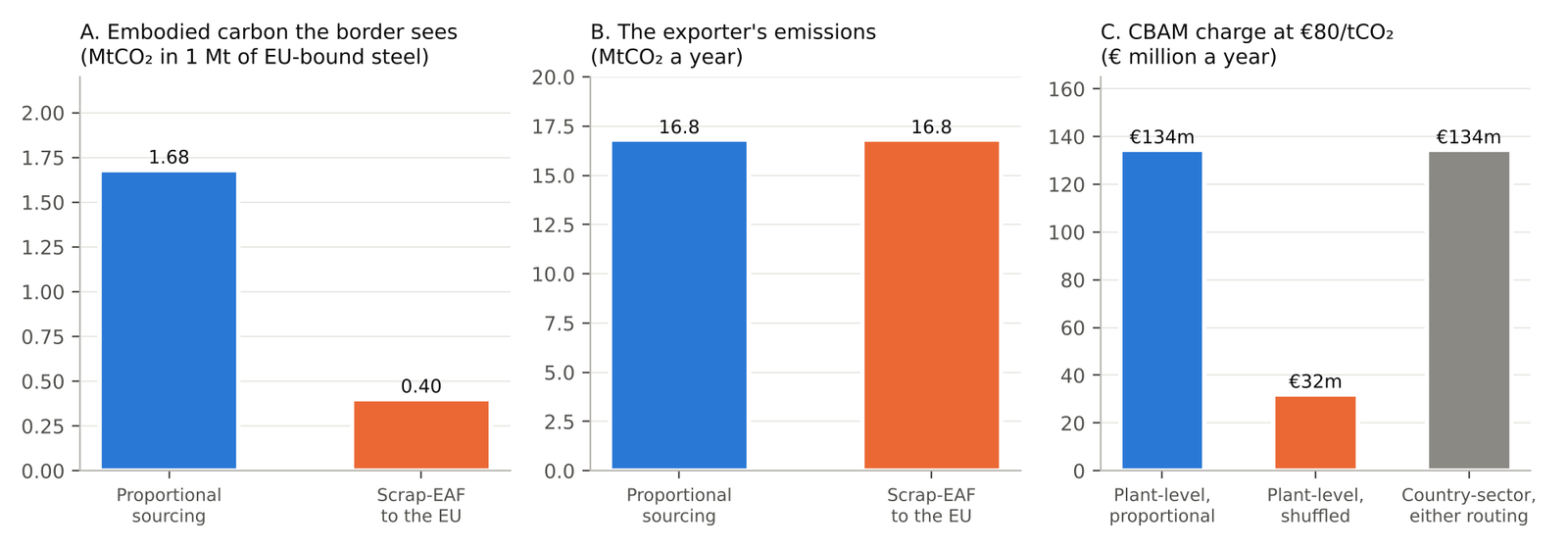
Scrap is limited, so the cut is mostly relabeling. The supply of scrap is set by how much steel reaches the end of its life (International Energy Agency 2020), so scrap used for Europe’s steel is replaced elsewhere by ore-based steel. The same move works for aluminum (Assous et al. 2024).
The stakes are of the same order as the charge itself. At €80, supplying Europe from scrap rather than at the country’s average saves €310 per tonne of hot-rolled steel for India, €223 for China and €162 for Türkiye (Table 1). Sandbag puts the bill on imports from China at €313 million a year if exporters reroute, against €590 million if they do not (Assous et al. 2024). The law asks the Commission to report on “resource shuffling” from 2028 but gives it no tool to stop it (European Parliament and Council of the European Union 2023b, Art. 30), and its December 2025 anti-circumvention proposal does not reach routing between plants (European Commission 2025b).
The rules credit payments, so a feebate earns nothing
The price paid and the price signal are different things. The price paid is what a producer hands over, on average, after rebates. The price signal is what each extra tonne of CO₂ per tonne of steel costs it, which is what drives investment in cleaner plants. For a flat carbon tax the two are the same. For a revenue-neutral feebate they diverge completely: each producer pays the carbon price on emissions per tonne above its sector’s average and is rebated below it, so every producer faces the full price at the margin while the average producer pays nothing (Brief 1.2).
The Commission’s draft rules net out exactly the rebate that makes a feebate work. The draft implementing regulation of May 2026 counts emissions “below an emission intensity baseline” as compensation to be deducted (European Commission 2026a, Art. 8(1)(b)(ii)). A feebate therefore earns no credit, although a carbon tax at the same rate, which produces the same cuts, would earn all of it. Returning revenue to industry is what makes a high carbon price passable in a large emitter, and it is what removes recognition (Brief 1.1).
The default carbon price, the only route for most exporters, covers explicit prices only. An exporter that declares default values can claim a reduction only through a yearly default carbon price, which the Commission “may” set from 2027 and only “where a carbon price was set by the rules applicable in the third country” (European Parliament and Council of the European Union 2025, Art. 9(4)). A consortium led by Technopolis is preparing the methodology for 2026–2028 from an inventory of emissions trading systems and carbon taxes (Technopolis Group 2026). For a country that prices carbon through fuel taxes, subsidy reform or a feebate, the default is zero, although such pricing has been measured for 142 countries (Agnolucci et al. 2024).
Measure by country and sector, and credit the country’s price signal
A single value for each exporting country and sector removes the gain from routing. If every tonne of hot-rolled steel from a country is charged at that sector’s verified average, updated each year, it no longer matters which plant ships it. Neuhoff et al. (2026) propose standardized values for all producers, and note that these give producers abroad no direct incentive to cut emissions.
On its own, a country average leaves each plant almost no incentive. A mill that cuts its emissions lowers the average for all its country’s exporters, so it keeps only a sliver of the reward. A mill with a tenth of its country’s output, selling a tenth of that to the EU, keeps €0.80 of each €80 it saves the country. A value fixed for years, like today’s default values, gives no incentive at all.
A domestic price signal supplies the missing incentive, and crediting it rewards the country for adopting one. A feebate at the EU price gives every plant the full €80 per tonne on all its output, not only the tenth sold in Europe. The proposed rule is that importers pay the EU price less a recognized foreign price, on the country-sector average carbon content, where the recognized price adds to the price paid a weight on the unpaid part of the signal (working paper, liability formula). The charge does not depend on which plant ships, and a feebate at the EU price stays the exporter’s lowest-cost choice. Mehling and Ritz (2023) proposed the same top-up for explicit carbon prices only.
Recognition changes what an exporting country would choose for itself. A country selling a tenth of its steel to the EU would choose a feebate of €8 under today’s rules and €21 with full recognition, because it bears the cost of abatement on all its output but gets relief only on EU sales. A feebate at the full EU price pays for itself once more than 24 percent of output goes to the EU, against half today (working paper, calibration).
The signal can be measured for any instrument, price-based or not. The Total Effective Carbon Price expresses a tax, feebate, subsidy reform or standard as the uniform carbon tax that would cut emissions by as much (Brief 6.1). It credits a policy’s effect on emissions, not its cost to producers.
Where an exporter has no price signal, firm-level verification should stay. Firms there should be measured on the whole output of all their plants making the good, so that they cannot pick which plant ships, as Mehling and Ritz (2023) suggest (working paper, design trade-off).
Recognition is worth hundreds of euros a tonne
Recognition matters most to the most carbon-intensive exporters, who have the most to gain from a feebate. For India, opting in with a feebate at €40 cuts the charge on hot-rolled steel by €274 a tonne: €103 from dropping the mark-up and €171 from recognition (Table 1). At €80 the charge disappears. For a country shipping 1 million tonnes a year to the EU, each €100 a tonne is €100 million a year.
| Exporter (default value, tCO₂ per tonne of steel) | Charge, default with mark-up | Gain from routing scrap-based steel | Fall in charge with a recognized feebate at €40 | Fall with a feebate at €80 |
|---|---|---|---|---|
| India (4.28) | 445 | 310 | 274 | 445 |
| China (3.19) | 331 | 223 | 204 | 331 |
| Ukraine (2.48) | 258 | 167 | 159 | 258 |
| Türkiye (2.43) | 252 | 162 | 155 | 252 |
| Vietnam (2.35) | 244 | 156 | 150 | 244 |
| Japan (2.10) | 218 | 136 | 134 | 218 |
| Brazil (1.62) | 168 | 98 | 104 | 168 |
The cost is a weaker level playing field, so phase it in
Full recognition would let a feebate country’s steel enter without a carbon charge while EU steel pays on all its emissions. Both would face the full price at the margin, but only EU producers would pay for their remaining carbon. That favors imports, and raises emissions where the imported steel is still dirtier (working paper, objections and limits). The full answer is a separate charge on consumption that falls on imported and EU-made goods alike (Brief 1.3).
Recognition should therefore rise as free allocation falls. Setting the recognition weight each year to one minus the factor that governs free allocation gives 2.5 percent in 2026, about half in 2030 and full recognition from 2034, or later if the phase-out is extended. Relocation should be reviewed before each step.
Recognizing a feebate’s signal needs an amendment. The law defines a carbon price as a “monetary amount paid” (European Parliament and Council of the European Union 2023b, Art. 3(29)) and nets rebates. The Commission can drop the mark-up and state which support measures reduce recognition by implementing act; crediting the signal itself needs Article 9 amended (working paper, legal pathway). Under trade law, crediting comparable effect by criteria any country can meet is easier to defend than crediting only instruments that resemble the EU’s own (Mehling et al. 2019). Governments have reason to overstate their price signal; published measures, computed by an independent body and updated yearly, limit the risk.
What to do
The European Commission should open its default carbon price method to consultation and widen it. Build it on the World Bank, IMF and OECD measures, set it by country and sector, and let it cover feebates and non-price policies measured as carbon-price equivalents.
It should offer a country-sector route in the 2027 revision of default values. Exporters whose sector has a recognized price signal would be charged at the verified sector average, updated yearly, without the mark-up. Elsewhere, firms would verify the whole output of all their plants.
It should state which support measures reduce recognition. Support paid for verified abatement should reduce nothing; output-based rebates should reduce only the price paid; support that rises with emissions or fuel use should reduce both.
It should propose amending Article 9 to credit the price signal, phased in with free allocation, and measure shuffling from installation-level declarations matched to customs data.
Exporting countries should consider a sector-wide feebate. It prices every tonne at a rate a tax could not reach politically, costs the treasury nothing and is the instrument these changes would reward (Brief 1.2).