Price Production and Consumption Separately
A Two-Track Architecture for Carbon Pricing in Open Economies
Carbon prices stay low in open economies because one instrument does two jobs: it pushes producers to cut emissions per unit of output, and it makes buyers pay for the carbon they use. The second job hurts exporters and spares imports. This brief gives each job its own instrument. A revenue-neutral feebate prices production at no cost to the treasury and with a small price effect. A carbon component of VAT, and forward obligations on fuel suppliers, price consumption, imports included. Climate finance above half the feebate rate makes adoption a gain, and border charges set by country turn leakage into a race to the top.
carbon pricing, feebates, output-based rebating, border carbon adjustment, destination-based taxation, policy crediting
Climate Fiscal Policy Brief No. 1.1, October 2026. Stephen J. Stretton, writing in a personal capacity. The views expressed are the author’s own and do not represent those of any institution with which he is or has been affiliated. The full analysis, with the model, proofs and calibration, is in the working paper.
Key messages
Read the full working paper → · Download this brief (pdf) · Slides (pdf)
One carbon price cannot do two jobs in an open economy. It should cut emissions per tonne of what a country makes, and it should make buyers pay for the carbon in what they use. Asking one tax to do both puts the cost on exporters and lets imports off, so governments keep the rate low.
Price production with a revenue-neutral feebate. Firms pay on emissions per tonne above their sector’s average and are rebated below it. The treasury neither gains nor loses, every firm still saves the full carbon price on each tonne it cuts, and prices barely move.
Price consumption at the destination. A carbon component of VAT charges imports and home-made goods alike and exempts exports; a forward-announced obligation covers fuel for homes and vehicles.
Pay for policies, not projects. A climate-finance payment per tonne above half the feebate rate makes adopting the feebate a gain for the country.
Charge imports by country and sector, and credit non-price policies. Exporters then do best by matching the importer’s charge at home: a race to the top.
One price, two jobs
Carbon prices are too low and too narrow to meet the Paris goals. Explicit carbon prices cover about 28 percent of global emissions, at an average of about $19 per tonne of CO₂ where they apply; averaged over all global emissions, the price is about $5 (World Bank 2025). The High-Level Commission on Carbon Prices judged that prices of at least $50–100 per tonne by 2030 are consistent with the Paris temperature goals (High-Level Commission on Carbon Prices 2017).
Part of the gap is built into the instrument. A carbon tax or an emissions trading system covers what a country produces. It does two jobs with one rate. It rewards each firm for cutting emissions per tonne of output, which is what the climate needs. And it raises the price of carbon-intensive goods, so that buyers use less of them. In a closed economy one rate does both jobs well.
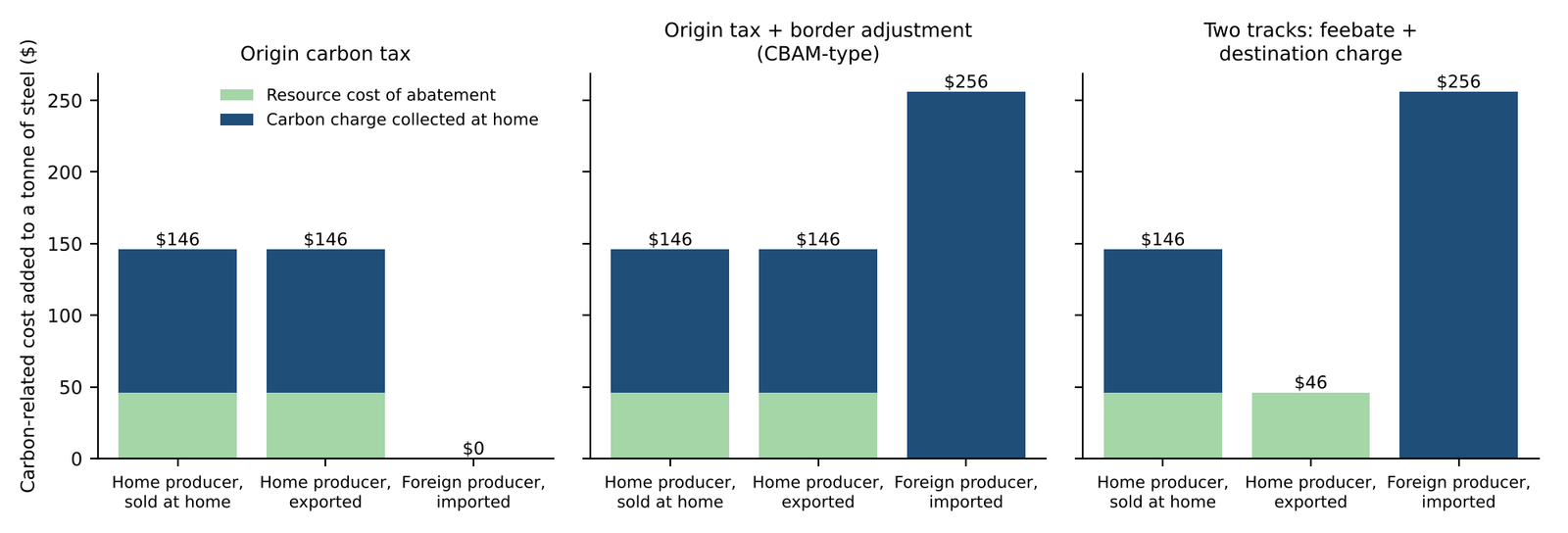
In an open economy the second job undermines the first. The price rise falls on exports, which compete against unpriced foreign supply, and spares imports, which replace home production. Some of the fall in home output is then replaced by foreign production, which is leakage, not abatement: model studies put leakage under unilateral pricing at 5–25 percent of the emission cut (Branger and Quirion 2014), and the loss of output is concentrated in energy-intensive, trade-exposed industries such as steel and cement. Governments respond by exempting heavy industry, handing out free permits or keeping the rate low (Keen et al. 2022).
A border charge on imports fixes only half the problem. The EU’s Carbon Border Adjustment Mechanism (CBAM) charges imports for their carbon (European Parliament and Council of the European Union 2023b). It protects the home market, but exports still carry the full carbon bill, and the mechanism credits only an explicit carbon price paid abroad, not other policies that cut emissions.
The proposal: two tracks
The production track prices emissions per tonne, not the carbon bill. Each covered sector, such as steel, cement, aluminum or power, has a benchmark: its average emissions per tonne of output. A firm above the benchmark pays the carbon price on the difference; a firm below it receives a rebate on the difference. Because the benchmark is the average, payments cancel out. The treasury neither gains nor loses, and the sector’s average cost barely moves. But each firm still saves the full carbon price on every tonne of CO₂ it cuts, exactly as under a tax. Canada’s output-based pricing system for industry works on the same principle (Government of Canada 2019), and the IMF has proposed the same formula for industry in Mexico (Black et al. 2021).
The consumption track charges what the country uses, wherever it was made. Every good bought at home carries a charge for the carbon embodied in it, collected as a carbon component of VAT. Imports pay it at the border, home-made goods pay it along the VAT chain, and exports are exempt, exactly as VAT already works (OECD 2017). The value part of VAT can be cut as the carbon part rises, so the total rate barely moves at first while its base shifts from value to carbon (Brief 1.3).
Fuel for homes and vehicles needs its own instrument. Its carbon is released after the last sale, so no charge on goods reaches it. A few large firms dominate its supply: fuel importers, refiners and gas suppliers. They take on a legal obligation for the carbon in what they sell, announced years ahead and rising on a published path, so that the firms that plan long-lived capital know the price they will face.
A common yardstick lets every policy be compared. A feebate has no “price paid”, and a standard or a procurement rule has no rate at all. The carbon-price equivalent expresses any of them as the uniform carbon tax that would cut emissions by as much (Brief 6.1). It is what lets a country that regulates, or uses a feebate, earn the same credit at a foreign border and the same climate finance as a country that taxes.
Together the two tracks give the full carbon price signal, without leakage. The feebate gives producers the full incentive to cut emissions per tonne. The consumption charge makes buyers pay for carbon, and because imports pay alike there is nothing to gain from buying abroad. The two rates can differ: the production rate can be high because it does not raise average costs, and the consumption rate can be set by what households will accept (working paper, the equivalence result).
What the feebate costs: steel
A feebate raises the producer price by the cost of the abatement only. A tax charges firms for every tonne they still emit; a feebate does not. So a feebate at a given rate raises costs by roughly a third as much as a tax at the same rate. The working paper calibrates this to the EU’s default emission values for hot-rolled steel, which differ widely by exporting country (working paper, calibration).
| Exporter (default intensity, tCO₂ per tonne of steel) | Carbon tax at $80/tCO₂ | Feebate at $80/tCO₂ |
|---|---|---|
| Japan (2.1) | +21% | +7% |
| Türkiye (2.4) | +25% | +8% |
| China (3.2) | +32% | +10% |
| India (4.3) | +43% | +14% |
The most carbon-intensive exporters gain most from choosing a feebate. Their carbon bill under a tax, which the feebate avoids, is largest. For most exporters a feebate at a rate close to the EU’s carbon price raises costs by a single-digit percentage.
The saving has a price: a feebate alone does not discourage consumption. Because it does not raise the average price much, it gives buyers little reason to use less steel, and to cut the same tonnes on its own it would need a higher rate than a tax (working paper, the output margin). The consumption track supplies that missing signal, on the consumption base where it causes no leakage.
Pay for policies, not projects
Climate finance can make a feebate a gain for the adopting country. Suppose a climate-finance facility pays a price per tonne of reduction below the country’s unpriced baseline. A feebate cuts emissions at an average cost of about half its rate, because the cheapest cuts come first. So any payment above half the feebate rate more than covers the cost, and the country’s best choice is a feebate rate equal to the payment (working paper, crediting). A World Bank analysis of payments for a donor-supported carbon tax finds the same half-the-rate threshold (Strand 2020).
Paying for a sector-wide policy avoids the weaknesses of project credits. Project credits pay for single installations whose additionality is contested. A feebate moves the intensity of a whole sector, which can be measured, and its rebate already rewards the clean plants a project would fund. The baseline is the hard part, as in all results-based finance; crediting the measured change in sector intensity from a verified pre-policy level limits the room to inflate it.
The threshold assumes the country keeps the reduction toward its own target. If the buyer counts it instead, under Article 6 of the Paris Agreement, the country must also be paid for the carbon, and the break-even payment rises to about one and a half times the feebate rate (Strand 2020).
From leakage to a race to the top
When importers charge for carbon by exporting country and sector, exporters gain by pricing carbon at home. If the EU or another importer charges for the carbon in steel at a value set for each exporting country and updated from verified data, no single mill can lower its country’s charge, but a national feebate can. An exporter’s lowest delivered cost then comes from a feebate at the same rate as the charge in its markets (working paper, best response).
Competition then rewards the cleanest producers. Under carbon taxes without border charges, a country that raises its price loses market share. Under the two tracks, a country that raises its feebate toward its markets’ charges gains share. In the working paper’s simulation of a steel import market with eight exporters, a charge of $100 per tonne cuts the average carbon content of imports by about 28 percent if exporters do nothing, through the mix of suppliers alone, and by about 70 percent if each responds with a feebate.
Today’s EU rules block half of this. The CBAM deducts only a carbon price “effectively paid” abroad, net of any rebate (European Parliament and Council of the European Union 2025), so a revenue-neutral feebate, which rebates on average all it charges, earns no credit, and measuring each plant separately lets exporters send clean steel to Europe and dirty steel elsewhere. The companion brief proposes measuring the foreign price signal by country and sector and crediting non-price policies as carbon-price equivalents (Brief 1.4).
Making it work
The feebate needs data that exporters to the EU are already learning to collect. It needs, for each sector, output, emissions measured at the plant and a benchmark rule. The CBAM already defines how plant emissions are measured in six sectors, and EU importers who want to pay less than the default values (European Commission 2025) must obtain those data from their suppliers (European Parliament and Council of the European Union 2023b). Updating the benchmark each period to the sector average removes windfalls for firms that were already clean.
The consumption charge rides on the VAT system. Countries without a working VAT cannot run it yet. They can still run the feebate, which is where most of their emissions are, and add the consumption charge later.
Trade rules are a design constraint, not a barrier. A charge levied equally on imported and home goods, with exports exempt, follows the logic of border adjustment of internal taxes under the GATT; whether carbon intensity can distinguish otherwise like products is unsettled (Mehling et al. 2019). A sector-wide feebate is not tied to exporting, but its rebate leg needs careful drafting under the subsidies rules (working paper, implementation).
The VAT carbon charge’s effect on poorer households must be measured before rates are set. Because the value part of VAT falls as the carbon part rises, the net effect depends on how much more carbon-intensive poorer households’ spending is, not on the carbon price as such (working paper, objections and limits).
What to do
Developing-country exporters: start with a production feebate. It prices carbon at a rate a tax could not reach, costs the treasury nothing, and, once importers recognize it, earns credit at the border. Begin with the sectors that already report plant emissions for the EU.
The EU and other importers: credit the policy, measured by its effect. Set border charges by exporting country and sector, update them from verified data, and credit feebates and non-price policies at their carbon-price equivalent. As free allocation is phased out (by 2034 under current law (European Parliament and Council of the European Union 2023a)), add a carbon component inside VAT so that home consumption pays the same charge as imports.
Development banks and climate-finance facilities: pay for policies. Offer a price per tonne for verified cuts in sector intensity, above half the feebate rate the payment is meant to induce. The adopting country then gains, and the payment buys a whole sector’s change rather than a single project.