Converting a VAT into a Destination Carbon Tax
A Carbon Component in VAT and a Forward Obligation on Energy Suppliers in the European Union
The European Union prices the carbon its power plants and factories emit, but not the carbon embodied in most of what Europeans buy: 40 percent of the carbon in households’ VAT-taxable purchases is emitted outside the Union. This paper proposes a carbon component inside VAT, charged at published default intensities that sellers may rebut and credited along the invoice chain, while the value component falls; and a legal obligation, fixed a decade ahead, on the few suppliers of fuel for homes and vehicles. With full crediting each firm pays on the carbon it adds, exempt stages break the chain, and deducting carbon prices paid upstream gives every tonne one price. An input–output calibration puts the taxable household basket at 0.41 kg CO₂e per euro in 2022, with imports from outside the Union carrying 1.7 times the carbon per euro of the same goods made inside it. Cutting the value component each year by the previous year’s carbon receipts keeps the swap revenue-neutral without a forecast. At €200 per tonne the swap costs the poorest fifth 0.4 percent of spending; returning the obligation’s receipts per household more than offsets that. The VAT component needs unanimity; the obligation does not.
carbon pricing, consumption-based emissions, value-added tax, destination basis, border carbon adjustment, EU law
Working paper, version 0.3, October 2026. Stephen J. Stretton, writing in a personal capacity. The views expressed are the author’s own and do not represent those of any institution with which he is or has been affiliated. A short version for policy makers is Climate Fiscal Policy Brief No. 1.3.
1 Executive summary
Policy brief (short version) → · Download this paper (pdf) · Slides (pdf)
Europe prices the carbon it emits, not the carbon it consumes. The EU Emissions Trading System (ETS) prices power and heavy industry inside the Union, and the Carbon Border Adjustment Mechanism (CBAM) extends that price to imports of cement, steel, aluminum, fertilizers, electricity and hydrogen. Nothing prices the carbon in an imported shirt, phone or sofa. On this paper’s calculation, 40 percent of the carbon embodied in what EU households buy subject to VAT was emitted outside the Union in 2022, and imports from outside the EU carried about 1.7 times as much carbon per euro as the same goods made inside it. A price on production misses that carbon and makes producing in Europe dearer than producing elsewhere for sale in Europe.
The proposal is a carbon component inside VAT. Every registered business would charge, on its sales, a carbon price per tonne of the carbon embodied in what it sells, and credit the carbon component on its purchases, as it credits VAT. Embodied carbon is read from a published default intensity for each product category, the EU-made average, the same for every origin, unless the seller proves a lower figure. Imports pay at the border and exports leave free of it. As the carbon component rises, the existing value component of VAT falls, so the reform replaces part of a tax rather than adding one.
The VAT chain does the hard work. With full crediting, each firm pays the carbon price only on the carbon it adds, and the final buyer bears it on the whole supply chain, exactly as VAT taxes value added at each stage and the full price at the end. Where an upstream firm has already paid a carbon price under the ETS, CBAM or a foreign scheme, its invoice carries that payment and the carbon component deducts it, so every tonne bears one price. Electricity, a taxable supply, carries its generation carbon to the household this way. The weak points are VAT’s own: exempt sectors break the chain, and misclassification pays more.
A simple rule keeps the swap revenue-neutral. The carbon in the basket will shrink at a rate nobody can forecast, so a fixed schedule of VAT cuts could gain or lose over €100 billion a year by 2037. Instead, each member state cuts its value component each year by the previous year’s carbon receipts. On a carbon price rising €20 a year to €200 per tonne in 2037, a 15 percent value component falls to between 10.8 and 12.7 percent, depending on how fast the economy decarbonizes. In the central case clean goods (0.10 kg CO₂e per euro) then pay 13.8 percent in total and carbon-intensive goods (0.80 kg per euro) 27.8 percent.
The swap is mildly regressive, and the fix is cheap. At €200 per tonne the carbon component takes about 5.5 percent of spending in every income group. Poorer households gain less from the value cut because more of their budget goes on rent, which is exempt, so the poorest fifth pays 0.4 percent of spending more and the richest 0.2 percent less. Because each member state recycles its own receipts, no money moves between member states.
Fuel for homes and vehicles needs a different instrument. Its carbon is released after the last sale, so VAT cannot reach it, and a few firms supply it, planning refineries and gas networks that last decades. A legal obligation on those suppliers, written into law with a price floor rising to €200 per tonne in 2037, would raise about €138 billion a year at that price, or €310 per resident. Returned as an equal amount per household, it more than offsets the swap’s regressivity: the poorest fifth gains 1.2 percent of spending.
The VAT component needs unanimity; the obligation does not. A carbon component changes the harmonized VAT system and needs a unanimous Council under Article 113 of the Treaty; the environmental legal basis does not avoid this. The obligation, an extension of ETS2 with a published price floor, can pass by qualified majority. So the sequence is: the obligation now, a legal opinion and a default schedule next, and the carbon component when the Council agrees or a coalition of member states moves first under national law.
2 Introduction
The EU prices carbon where it is emitted, and much of the carbon Europeans cause is emitted somewhere the EU cannot price. The ETS covers power and heavy industry inside the Union, and CBAM extends that price to imports of cement, iron and steel, aluminum, fertilizers, electricity and hydrogen (European Parliament and Council of the European Union 2023b). Nothing prices the carbon in an imported shirt, phone or sofa. In 2022 the final demand of EU residents caused 3.7 Gt of greenhouse gases along global supply chains, plus 0.7 Gt that households emitted directly from boilers and cars (Eurostat 2026d). On my calculation (Section 5), 40 percent of the carbon embodied in what households buy subject to VAT was emitted outside the EU, and imports from outside the EU embody about 1.7 times as much carbon per euro as the same products made in the EU. A price on production leaves that carbon unpriced and makes producing in Europe dearer than producing elsewhere for sale in Europe (Peters and Hertwich 2008; Peters et al. 2011; Davis and Caldeira 2010).
Production pricing is also near its political limits. Explicit carbon prices cover about 28 percent of global emissions; averaged over all global emissions the price is about $5 per tonne (World Bank 2025), against a social cost of carbon estimated at $185 per tonne in 2020 dollars (Rennert et al. 2022). Inside the EU, a higher price on production meets the objection that it handicaps exporters, and a new price on households meets the cost-of-living objection that has already delayed ETS2 to 2028 (European Parliament and Council of the European Union 2026). A consumption price that replaces part of an existing tax, rather than adding a new one, answers both: it does not fall on exports, and it need not raise the average tax on consumption.
The question is how the EU could price the carbon in consumption, wherever it is emitted, using institutions it already has. The answer proposed here is the consumption track of the series’ two-track architecture (Stretton 2026d), in two parts. The first is a carbon component of VAT. Each registered business charges, on its sales, a carbon price per tonne of the embodied carbon in what it sells, and credits the carbon component on its purchases, exactly as it credits VAT. Embodied carbon is read from a published default intensity for the product category, the EU-made (sector) average, the same for every origin, unless the seller proves a lower figure. Exports are zero-rated and imports are charged at the border, so the charge is levied on the destination basis, as VAT is. As the carbon component rises, the existing value component of VAT falls, by a rule that keeps the swap revenue-neutral. The second part is a forward obligation: a legal duty, written into law ten years ahead with a published price floor, on the few firms that supply road and heating fuel to pay for the carbon in the fuel they sell. Fuel burned in homes and cars never passes through a goods chain, so VAT cannot reach it.
The idea of a carbon tax run through the VAT credit chain is not new, and the paper’s contribution must be stated against its precedents. Courchene and Allan (2008) proposed a destination-based “carbon-added tax” for Canada, operating like a VAT (Courchene and Allan 2011). McAusland and Najjar (2015) analyzed a carbon footprint tax modeled on a credit-method VAT, found a pure version, with a footprint for every product, probably too costly, and proposed a hybrid in which firms either compute their own footprints or use default footprints for their product class. That hybrid is the design here. McLure (2010) made the strongest case against: carbon content is unobservable, so a carbon-added tax needs footprinting on every invoice at a compliance cost out of proportion to its gain, and an upstream tax with border adjustments for a few basic products does better. The European proposal for a consumption charge on carbon-intensive materials (Ismer et al. 2016; Pollitt et al. 2020; Neuhoff et al. 2026) takes McLure’s side on coverage: an excise-like charge on a handful of materials at benchmark intensity, applied equally to imports.
Against that work the paper makes five contributions.
- The chain results, stated with their conditions (Section 4). With full crediting, each firm remits the carbon price on the carbon it adds, and the final consumer bears it on the whole supply chain (Proposition 1). An exempt stage breaks the chain and makes upstream carbon cascade (Proposition 2). Deducting carbon prices paid upstream, under the ETS, CBAM, the forward obligation or a recognized foreign scheme, gives each tonne one price and links the consumption track to the production track (Proposition 3). A carry-forward rule is what lets a verified low intensity reach the consumer price.
- Calibrated defaults (Section 5). A multi-regional input–output calculation from Eurostat’s FIGARO tables gives default intensities for 23 product categories. The taxable household basket embodied 0.41 kg CO₂e per euro in 2022, and imports from outside the EU 0.76 kg per euro against 0.45 for the same mix of products made in the EU.
- A neutrality rule (Section 6). Cutting the value component each year by the previous year’s net carbon receipts keeps the swap revenue-neutral without forecasting decarbonization. On the illustrative path to €200 per tonne in 2037, the value component ends between 10.8 and 12.7 percent.
- The forward obligation (Section 8): ETS2 with a published price floor rising for a decade, for the carbon that never enters a goods chain.
- A legal map (Section 9). The carbon component is a change to the VAT system and needs unanimity under Article 113 TFEU; Article 192(2)(a) does not avoid this. A national version may survive the ban on other turnover taxes only if levied per tonne. The forward obligation can be adopted by qualified majority, as ETS2 was.
Section 7 reports the distributional effects, Section 10 administration and fraud, and Section 11 the objections, McLure’s first. Production is priced separately on the series’ production track, by a revenue-neutral feebate on emissions intensity (Stretton 2026b); recognition of foreign carbon prices at the border is developed in Stretton (2026a) and the measurement framework in Stretton (2026c).
3 Related literature
The paper connects five literatures; Appendix A reviews them in more detail.
Consumption-based accounting. High-income economies are net importers of embodied carbon. Emissions from producing traded goods rose from 20 to 26 percent of the global total between 1990 and 2008, and net transfers from developing to developed countries rose from 0.4 to 1.6 GtCO₂ (Peters et al. 2011); in several European countries more than 30 percent of consumption-based emissions are imported (Davis and Caldeira 2010). Pricing all embodied emissions is not first-best, because a tonne imported is not a tonne added globally (Jakob et al. 2014). The case for a consumption charge rests instead on leakage, administration and acceptability.
Carbon-added and footprint taxes. Courchene and Allan (2008) proposed a destination-based carbon-added tax operating like a VAT, and McLure (2010) argued against it on compliance cost and border-adjustment grounds. McAusland and Najjar (2015) analyze the credit-method version formally and propose default footprints by product class; Eichner and Pethig (2015) show that a unilateral consumption-based carbon tax can produce negative leakage.
Consumption charges on carbon-intensive materials. The closest policy proposal is the consumption charge, or “climate contribution”, on carbon-intensive materials, levied at benchmark intensity on domestic and imported products alike. Ismer et al. (2016) designed it legally, as an excise-like charge at product-specific benchmark intensity applied equally to imports; Pollitt et al. (2020) modeled it, finding that a charge rising to about €80 per tonne by 2050 cuts EU CO₂ emissions by up to 10 percent by 2050 and, because imports are charged alike, avoids leakage; Grubb et al. (2022) place it among three trade-compatible options; and Neuhoff et al. (2026) restate it with standardized values, the same for every origin, to stop exporters shuffling their cleanest output to the EU.
Destination-based taxation and VAT. VAT is levied on the destination basis: goods and services are taxed where they are consumed, exports are relieved and imports are charged (OECD 2017). VAT has spread to most of the world’s economies within half a century (Keen and Lockwood 2010). For a uniform tax, origin and destination bases are equivalent in their real effects (Lockwood et al. 1994); Lockwood and Whalley (2010) apply the point to carbon border adjustments. It follows that VAT’s value component, being uniform, carries no carbon incentive, which is why the World Bank’s total carbon price excludes general VAT and counts only preferential VAT rates on fuels, as subsidies (Agnolucci et al. 2024). The carbon component is what turns part of VAT into a carbon price.
Border adjustment and trade law. The design literature sets out the choices of coverage, measurement and treatment of exports (Ismer and Neuhoff 2007; Mehling et al. 2019; Keen et al. 2022). Keen et al. (2022) recommend domestic benchmarks first and country-specific values later. Mattoo et al. (2009) find that a border tax on the carbon content of imports, measured at the exporter’s own intensity, would cut China’s manufacturing exports by about a fifth, while one based on the carbon content of domestic production would do far less damage. Evans et al. (2021) note that a border adjustment on imports alone leaves exporters exposed; a VAT-based charge zero-rates exports by construction.
Credibility, leakage and distribution. Governments cannot bind successors to future tax rates, so firms discount announced carbon prices (Kydland and Prescott 1977; Helm et al. 2003; Brunner et al. 2012); carbon contracts for difference are one answer for industrial investment (Chiappinelli and Neuhoff 2020), and the forward obligation applies the same idea to fuel suppliers. Model studies find leakage of 5–25 percent of the emission cut without border adjustment (Branger and Quirion 2014), while ex-post studies find no detectable leakage from the ETS so far (Naegele and Zaklan 2019; Dechezleprêtre et al. 2022), so the case concerns the higher prices ahead. Holland (2012) shows that an intensity standard paired with a consumption tax can sometimes reach the first best when regulation is incomplete, and Böhringer et al. (2017) that output-based rebating plus a consumption tax on emission-intensive, trade-exposed goods can be equivalent to a border carbon adjustment: the formal case for pairing this consumption track with a production feebate. Household carbon rises less than proportionally with income (Sager 2019), and a consumption-based EU carbon price is roughly neutral within member states but regressive across them (Feindt et al. 2021).
What is new. The literature has the carbon-added tax as an idea, its formal analysis with default footprints, the materials charge with standardized values, and the credibility argument. This paper adds the chain results with their failure cases and the one-price-per-tonne deduction that links the consumption track to the ETS, CBAM and a feebate; a calibration of defaults for the whole taxable basket of a large economy; a swap inside the existing VAT with a rule that keeps it neutral; the forward obligation for fuel that never enters a goods chain; and an analysis of the legal design choice that decides whether a national version is a prohibited turnover tax.
4 The carbon component in the VAT chain
A carbon price credited through the VAT chain taxes each firm’s carbon added, as VAT taxes value added; this section states the conditions and the failure cases.
Setup. A good passes through \(n\) stages. Stage \(k\) buys the output of stage \(k-1\), adds value \(w_k\) and emits \(a_k\) tonnes of CO₂e itself, its carbon added. Its sales value net of tax is \(p_k = p_{k-1} + w_k\), and the embodied carbon of its output is \(E_k = \sum_{j=1}^{k} a_j\). The value component of VAT has rate \(v\); the carbon component has price \(P\) per tonne. Each firm’s invoice states a carbon base \(C_k\) in tonnes: either a default, \(C_k = d_k\, p_k\), where \(d_k\) is the published intensity per euro for its product category, or a verified figure. Firm \(k\) remits \[ T_k = v\,(p_k - p_{k-1}) + P\,(C_k - C_{k-1}), \tag{1}\] charging tax on its sales and crediting the tax on its purchases. Some firms also pay an explicit carbon price \(q_k\) per tonne on their own emissions: the ETS price, a CBAM certificate, the forward obligation of Section 8, or a recognized foreign carbon price.
Proposition 1 (carbon added). With full crediting at every stage: (i) total carbon-component receipts are \(P\,C_n\), whatever the carbon bases at earlier stages; (ii) if every stage’s base equals its embodied carbon, \(C_k = E_k\), each firm remits \(P\,a_k\), the carbon price on its carbon added; (iii) the final consumer then bears \(P\,E_n\), the carbon price on the good’s whole supply chain.
The proof, in Appendix B, is a telescoping sum. Three implications matter for design. First, only the base at the final sale fixes what the consumer pays; earlier bases decide only who remits and when, as with VAT. Second, the base must fall per euro along the chain, because later stages add value with little carbon. In the worked example below the embodied intensity is 2.0 kg per euro at the steel mill and 0.65 kg per euro at the till. A single per-euro default applied at every stage would overcharge at retail by the ratio of retail to producer value, which is why Table 2 reports intensities both at basic prices, for the border and sales between firms, and at purchasers’ prices, for the final sale. Third, a firm whose output base is smaller than its input base, \(C_k < C_{k-1}\), is due a refund, the same opening that VAT refund fraud exploits (Section 10). Defaults should therefore be consistent along a chain, so that published bases never imply negative carbon added.
Carry-forward: how a verified figure reaches the consumer. Proposition 1(i) has an awkward corollary. If an importer verifies a low intensity but the retailer still charges the retail default on the retail value, the importer lowers only its own remittance, the retailer remits more, and the consumer price does not move. Rebuttal reaches the consumer only if each downstream firm may set its base as the bases on its purchase invoices plus its own carbon added, \(C_k = C_{k-1} + a_k\), with \(a_k\) either verified or read from a published default per euro of value added for its sector. Under this carry-forward rule a verified base travels down the chain, and a seller that verifies an intensity below the default lowers its customers’ tax and gains market share; the clean producer then faces a marginal price of \(P\) per tonne on what it sells in the EU. Each firm will use carry-forward only when it gives a lower base than the default, which is the incentive working as intended, but it means the final-sale default no longer polices firms whose inputs carry verified bases. Verified claims therefore need audit (Section 10).
Incentives without rebuttal. Under defaults alone, a firm’s charge does not depend on its own emissions, so the carbon component shifts demand between product categories but gives no reason to cut intensity within one. That incentive comes from rebuttal. Rebuttal is optional, so only producers below the default use it, and the default must be set no lower than the average it replaces, or dirty producers keep the undercharge (Section 5).
Proposition 2 (exempt stages). Let stage \(j\) be exempt: it charges no tax on its sales and cannot credit tax on its purchases, so its input taxes \(v\,p_{j-1} + P\,E_{j-1}\) become a cost in its price. (i) If \(j = n\), the consumer bears the carbon price on upstream carbon, \(P\,E_{n-1}\), once, but the exempt firm’s own carbon \(a_n\) goes uncharged by the carbon component. (ii) If \(j < n\) and later bases are correct, the consumer pays \((1+v)\,(v\,p_{j-1} + P\,E_{j-1})\) more than under full crediting: carbon upstream of the exempt stage is charged twice, and the value component is charged on the tax embedded in the exempt firm’s price.
Exemption breaks the carbon chain exactly as it breaks the VAT chain. Financial services, insurance, letting of housing, health, education and social care are exempt under Articles 132 and 135 of the VAT Directive (Council of the European Union 2006), and public bodies are largely outside its scope. Together they made up 31 percent of EU household spending in 2022 (Table 2), and their own carbon intensity is low, 0.06–0.10 kg CO₂e per euro. Final-stage exemption therefore leaves little carbon unpriced, and a hospital’s boiler is reached by the forward obligation instead. The cascade in case (ii) matters where exempt firms sell to taxable ones, as banks and insurers do. Take a bank that buys €10,000 of computers embodying 3 tonnes of CO₂e in 2032, when the carbon price is €100. It cannot credit the €300 carbon component, which becomes a cost of its services. If it sells those services to a taxable manufacturer, the €300 sits in the manufacturer’s costs but on no invoice it can credit, while the manufacturer’s own sales carry a base that already counts the carbon in its suppliers’ computers. The 3 tonnes are charged twice, and the value component is charged once more on the €300. Two remedies already exist in VAT: the option to tax certain exempt supplies, and zero-rating with a right of deduction, which restores Proposition 1.
Proposition 3 (one price per tonne). Let each invoice carry, besides the carbon base, the carbon price already paid, \(Q_k = \sum_{j=1}^{k} \min(q_j, P)\, a_j\), and let the carbon component on a sale be \(P\,E_k - Q_k\). Then firm \(k\) remits \((P - \min(q_k, P))\,a_k \ge 0\), and every tonne bears a total price of \(\max(P, q_k)\): exactly \(P\) wherever upstream prices do not exceed it.
Table 1 works through a three-stage chain in 2032 (Figure 4 in Appendix B plots it), when the carbon price on the illustrative path is €100 per tonne and the value component 12.5 percent. A steel mill emits 400 kg in making €200 of steel and pays the ETS at a stylized €80 per tonne, €32. An appliance maker turns the steel into a €500 appliance, adding 100 kg; a retailer sells it for €800, adding 20 kg. The value component raises 12.5 percent of €800, €100, split by value added. The carbon component raises €20: the mill remits €8 (\(40 - 32\)), the maker €10 and the retailer €2. With the ETS payment, the 520 kg in the appliance bear €52, exactly €100 per tonne.
2.Source/check_propositions.py.
| Stage | Sales value (€) | Carbon added (kg) | Embodied (kg/€) | Value component (€) | ETS paid (€) | Carbon component (€) |
|---|---|---|---|---|---|---|
| Steel mill | 200 | 400 | 2.00 | 25.0 | 32 | 8 |
| Appliance maker | 500 | 100 | 1.00 | 37.5 | 0 | 10 |
| Retailer | 800 | 20 | 0.65 | 37.5 | 0 | 2 |
| Total | 520 | 100.0 | 32 | 20 |
Proposition 3 states the link to the production track (Stretton 2026d). Deductions count explicit prices paid per tonne, averaged over the sector that paid them. A revenue-neutral feebate charges dirty producers and rebates clean ones, so its average net price is zero and it earns no deduction: a good made under a feebate pays the full carbon component at consumption, while the feebate supplies the marginal incentive at production. Exports are zero-rated, so the exporter reclaims the carbon component on its inputs and its output carries only the production-track price, which is 1.1’s equivalence result restated through the VAT chain (Stretton 2026d). Two limits keep the deduction honest. It is capped at \(P\) per tonne, or a tonne priced above \(P\) upstream would draw a refund from the carbon component. And where bases are defaults rather than verified, a default can understate the carbon in an ETS-heavy chain, so the carbon component on a sale is \(\max(P\,C_k - Q_k, 0)\): the deduction can cancel the charge but never turn it into a refund. Where an exempt firm sits in the chain (Proposition 2), it issues no carbon invoice, so carbon prices paid upstream of it are lost to the deduction too and the cascade is larger still.
Electricity. Electricity is a taxable supply sold on an invoice, so the carbon component carries its generation carbon to the final user, household or firm, in the same way as any other good. The generator’s invoice carries its carbon base and the carbon price it has already paid: the ETS price in the EU, or under a revenue-neutral power-sector feebate (Stretton 2026b) nothing on average, because generators pay nothing net on average, so on average nothing is deducted. The final user therefore pays the full consumption price on electricity’s carbon through the VAT invoice, net of whatever production-track price was paid. No separate obligation on electricity suppliers is needed where a carbon component exists; where it does not, as in most developing countries at the start, 1.1 extends the supplier obligation to electricity retailers on the same net basis (Stretton 2026d).
Imports and exports. An imported good enters the chain at the border. The importer pays the carbon component on the customs value at the default for its category, less any CBAM price paid on the same tonnes, and credits it in its next return, as it credits import VAT; from there Proposition 1 applies unchanged. An exporter zero-rates its sales and reclaims the carbon component on its inputs, so the export leaves carrying no EU consumption charge. Proposition 1(i) gives the system VAT’s self-enforcing property. An importer that understates value or intensity at the border lowers its own payment, but not what the consumer pays: the retailer still charges the retail default on the retail value, and the shortfall is collected from the firms in between, which have no input credit to offset it. The final-sale default is the main line of defense, as the retail rate is for VAT, for every chain whose inputs carry default bases.
5 Default intensities and rebuttal
The default intensities are the whole design: they fix the base for every seller that does not verify, which at the start is nearly all of them. This section calibrates them, sets the rule for domestic goods, imports and rebuttal, and checks the rule against trade law.
Method. I built an environmentally extended multi-regional input–output model from Eurostat’s FIGARO inter-country table for 2022, which covers 49 economies plus the rest of the world and 64 products (Eurostat 2026b), and Eurostat’s greenhouse gas emissions by country and industry from its footprint dataset (Eurostat 2026d). Multipliers give the CO₂-equivalent embodied per euro of each country’s output of each product; EU household purchases weight them into intensities by category and origin. The model reproduces Eurostat’s own estimate of the EU footprint to within 0.2 percent (3,749 against 3,743 Mt CO₂e, excluding households’ direct emissions). Appendix C gives the details and the code.
Table 2 reports the result for 23 categories. Intensities at basic prices apply at the border and between firms. Intensities at purchasers’ prices spread households’ purchases of wholesale and retail trade services, 64 percent of the basic value of the goods they buy, across those goods, and apply at the final sale.
2.Source/calibrate_defaults.py and 2.Source/defaults_by_category.csv.
| Product category | Share of household spending (%) | Imported from outside EU (%) | All origins, basic prices | EU-made | Extra-EU | All origins, purchasers’ prices | CO₂ only, purchasers’ prices |
|---|---|---|---|---|---|---|---|
| Electricity, gas, steam | 3.5 | 1 | 1.35 | 1.34 | 2.44 | 1.35 | 1.19 |
| Air transport | 0.6 | 23 | 1.19 | 1.20 | 1.15 | 1.19 | 1.10 |
| Agricultural and fishery products | 2.1 | 15 | 1.23 | 1.12 | 1.91 | 0.81 | 0.27 |
| Refined petroleum products | 2.3 | 14 | 0.91 | 0.88 | 1.10 | 0.61 | 0.43 |
| Minerals, metals, metal products | 1.0 | 47 | 0.88 | 0.73 | 1.05 | 0.60 | 0.43 |
| Water supply, sewerage, waste | 1.1 | 0 | 0.59 | 0.58 | 2.97 | 0.59 | 0.27 |
| Land and water transport, logistics | 2.9 | 7 | 0.43 | 0.41 | 0.70 | 0.43 | 0.38 |
| Processed food, beverages, tobacco | 8.7 | 7 | 0.59 | 0.57 | 0.87 | 0.42 | 0.23 |
| Chemicals and pharmaceuticals | 1.6 | 23 | 0.50 | 0.47 | 0.62 | 0.37 | 0.30 |
| Rubber and plastic products | 0.4 | 18 | 0.47 | 0.41 | 0.74 | 0.35 | 0.28 |
| Wood, paper, printing | 0.7 | 9 | 0.46 | 0.44 | 0.70 | 0.34 | 0.28 |
| Textiles, clothing, footwear | 2.0 | 49 | 0.46 | 0.30 | 0.62 | 0.34 | 0.27 |
| Electronics and electrical equipment | 1.6 | 34 | 0.39 | 0.28 | 0.63 | 0.30 | 0.25 |
| Furniture and other manufactured goods | 1.4 | 23 | 0.37 | 0.26 | 0.77 | 0.29 | 0.24 |
| Construction | 0.9 | 0 | 0.29 | 0.29 | 0.49 | 0.29 | 0.24 |
| Machinery and equipment | 0.2 | 13 | 0.34 | 0.28 | 0.71 | 0.27 | 0.22 |
| Motor vehicles, other transport equipment | 2.9 | 17 | 0.34 | 0.29 | 0.56 | 0.27 | 0.22 |
| Accommodation and food services | 8.4 | 0 | 0.21 | 0.21 | 0.40 | 0.21 | 0.14 |
| Wholesale and retail trade services | 16.0 | 2 | 0.16 | 0.16 | 0.33 | 0.16 | 0.13 |
| Communication, business, personal services | 10.9 | 5 | 0.14 | 0.14 | 0.22 | 0.14 | 0.12 |
| Exempt: public administration, education, health, social care | 6.0 | 0 | 0.10 | 0.10 | 0.12 | 0.10 | 0.08 |
| Exempt: real estate services, including imputed rent | 19.1 | 0 | 0.07 | 0.07 | 0.09 | 0.07 | 0.05 |
| Exempt: financial services and insurance | 5.8 | 10 | 0.06 | 0.06 | 0.07 | 0.06 | 0.05 |
| Taxable basket | 69.0 | 8 | 0.41 | 0.38 | 0.76 | 0.29 (basic) |
Four results stand out. First, the taxable household basket embodied 0.41 kg CO₂e per euro, or 0.29 kg if only CO₂ is counted, and 40 percent of that carbon (851 of 2,116 Mt) was emitted outside the EU. Second, imports from outside the EU are more carbon-intensive than EU-made goods in every manufacturing category. The headline comparison in Table 2, 0.76 kg per euro for extra-EU imports against 0.38 for EU-made purchases, overstates the gap, because EU-made purchases include low-carbon services. Like for like, the EU-made versions of the same mix of products embody 0.45 kg per euro, so imports carry about 1.7 times as much carbon per euro; the ratio runs from 1.3 for chemicals to 3.0 for furniture, with machinery at 2.5, electronics at 2.3 and textiles at 2.1 (Figure 1). Third, the categories most charged per euro are electricity, flights, farm products and fuel, which are also those where the forward obligation and the ETS already apply, so the deduction of Proposition 3 matters most there. Fourth, methane and nitrous oxide triple the intensity of farm products (0.81 against 0.27 kg CO₂ only, at purchasers’ prices). Pricing CO₂ alone would exempt most of the carbon in food.
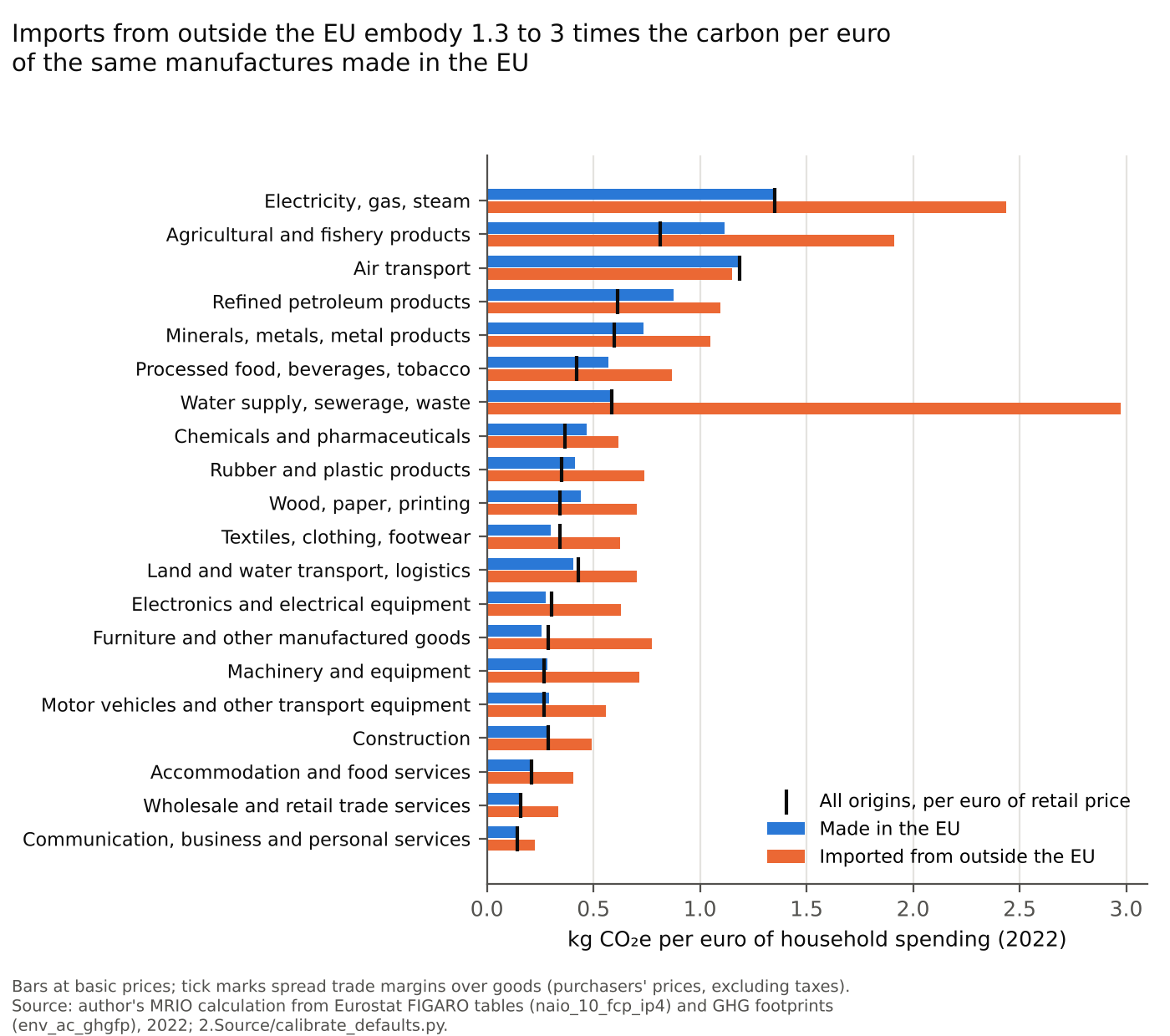
2.Source/make_wp_figures.py.
The calibration is a starting point, not a schedule ready to legislate. FIGARO’s 64 products are coarser than customs categories: “electronics” covers both a phone and a cable. Defaults per euro also fall with inflation, by 12 percent between 2022 and 2023 on the same method, partly through decarbonization and partly through prices. The legislated schedule would be built at a finer level, the 4- or 6-digit level of the Combined Nomenclature for goods, where customs data also allow defaults per physical unit, as CBAM does per tonne of steel (European Parliament and Council of the European Union 2023b), and it would be updated each year.
One schedule: the sector average, the same for every origin. The default for each category should be the average intensity of EU production of that category, the sector average, applied to every seller whatever the origin of the good: at basic prices at the border and between firms, and at purchasers’ prices, with trade margins spread over goods, at the final sale. Domestic goods then carry the sector-average embodied intensity through the VAT chain, and imports carry the same default, which their importers may rebut. By Proposition 1(i) it is the final-sale default that decides what consumers pay, so it must follow the same rule. A final-sale default at the all-origins average would collect from the importer’s customers whatever the border default left uncollected, and would make EU-made goods in the same category pay for imported carbon.
Three reasons support one default per category rather than country-specific values. It treats like products alike whatever their source, which is the strongest position under the national-treatment rule for internal taxes in GATT Article III:2 (Ismer and Neuhoff 2007; Mehling et al. 2019). It avoids the trade shock that Mattoo et al. (2009) find from charging imports at the exporter’s own intensity. And it removes the gain from resource shuffling, sending the cleanest output to the EU, which origin-specific values invite (Neuhoff et al. 2026). The cost is that the schedule is generous to imports at first: like for like, an EU-made default charges imports at about 60 percent of their embodied carbon (0.45 against 0.76 kg per euro). Across the whole taxable basket, where imports are 8 percent of spending, the schedule charges 0.39 kg per euro against 0.41 embodied, about 6 percent less. That is a price worth paying to avoid a trade dispute in the first years; the gap closes as rebuttal and tightening proceed, and the neutrality rule of Section 6 works on actual receipts, so it absorbs the shortfall.
Rebuttal turns the defaults into an incentive. An importer or producer whose verified intensity is below the default pays on its own figure, and carry-forward (Section 4) takes that figure to the till. Take a €100 phone imported in 2032, when the carbon price is €100 per tonne. The default for electronics at basic prices, the EU-made average, is 0.28 kg CO₂e per euro, so the importer pays €2.80. Electronics imported from outside the EU average 0.63 kg per euro, and Chinese-made electronics 0.84 (2.Source/defaults_by_category.csv), so the default undercharges the average import by €3.50 and the Chinese one by €5.60. An exporter that verifies 0.15 kg per euro pays €1.50 and gains €1.30 a phone over its rivals on the default; one at 0.84 has no reason to verify. The verification standard should be plant- or firm-wide intensity for the product, not consignment-level figures, so that a clean line cannot be reserved for EU buyers (Neuhoff et al. 2026). The verification infrastructure already exists for CBAM goods, whose monitoring rules and accredited verifiers could extend to other categories over time. Once importers charge embodied carbon at the exporting country’s verified intensity, an exporter’s most competitive policy at home is a production feebate at the same rate (Stretton 2026d), which turns competition toward lower carbon.
Tightening. Defaults can move from the EU average toward origin-specific values, with a deduction for carbon prices paid abroad as CBAM allows (European Parliament and Council of the European Union 2025; Stretton 2026a), once verified data cover enough of each category. Keen et al. (2022) recommend the same sequence: domestic benchmarks first, country-specific values later.
Governance. The Commission would publish the schedule each year by implementing act under the amending Directive, on a published method and data, with intensities per euro indexed to prices and, where customs data allow, per physical unit. Member states would not set their own defaults, because a lower default for a member state’s own producers would be a covert subsidy. A category’s default should change only once a year and by a published formula, so that firms can invoice on it with certainty.
Trade law. The carbon component is an internal tax on products, applied equally to domestic and imported goods and adjustable at the border under GATT Articles II:2(a) and III:2. The open question is whether embodied carbon, a characteristic of how a product was made, can differentiate otherwise like products; a pen made with coal power and one made with solar power are physically identical (Mehling et al. 2019). A default that is the same for every origin sidesteps the question for products that do not rebut, because like products then bear the same tax. Rebuttal raises it in a form that should survive: every seller, domestic or foreign, has the same right to pay on a verified figure below the default, and no imported product pays more than a like domestic product on the default.
6 Fiscal design: the carbon charge partly replaces VAT
The carbon component should replace part of the value component by a rule rather than by a fixed path, because the base it taxes is shrinking at an unknown rate.
Scale. EU member states raised €1,198 billion of VAT in 2022, 7.4 percent of GDP (Eurostat 2026e). Taxable household spending, the core of the base, was €5.1 trillion at basic prices (Table 2). Each percentage point of the value component on that base is worth €51 billion; half a point is worth €26 billion. A carbon price of €20 per tonne on the taxable basket at 0.41 kg per euro raises €42 billion before deductions. The base is narrower than total household spending of €8.2 trillion at purchasers’ prices (Eurostat 2026c) because rents, finance, health and education are exempt, and the Commission puts revenue forgone through exemptions and reduced rates, the actionable VAT policy gap, at €742 billion in 2023 (European Commission 2025).
Break-even intensity. Take an illustrative path on which the value component falls 0.5 points a year from 15 percent in 2027 and the carbon price rises €20 a year to €200 in 2037. A carbon price \(P\) euros per tonne on a good of intensity \(e\) kg per euro adds \(Pe/10\) percentage points, so the two changes cancel at 0.25 kg per euro. Whether the swap raises or loses money depends on the basket’s intensity net of deductions in each year (Table 3).
2.Source/make_wp_figures.py.
| Basket intensity in 2037 (kg CO₂e/€) | 0.15 | 0.20 | 0.25 | 0.30 | 0.41 |
|---|---|---|---|---|---|
| Carbon component receipts, gross (points of base) | 3.00 | 4.00 | 5.00 | 6.00 | 8.24 |
| Receipts net of ETS deduction (points of base) | 2.66 | 3.55 | 4.44 | 5.33 | 7.31 |
| Revenue-neutral value component (%) | 12.3 | 11.5 | 10.6 | 9.7 | 7.7 |
| Revenue change on the fixed path, value component 10% (points) | −2.3 | −1.5 | −0.6 | +0.3 | +2.3 |
| … in € billion (2022 base of €5.1 trillion) | −120 | −74 | −29 | +17 | +119 |
The basket’s intensity in 2037 is unknown within a factor of two. It fell 12 percent per euro between 2022 and 2023, partly through inflation; the EU’s targets imply continued falls in real terms; and the carbon component itself shifts spending toward cleaner goods. A fixed path from 15 to 10 percent loses €120 billion a year if the basket reaches 0.15 kg per euro and gains €119 billion if it stays at 0.41. Neither is neutral.
The neutrality rule. Each year’s value component should equal its starting rate less the previous year’s net carbon-component receipts as a share of the base: \[ v_t = v_0 - \frac{R_{t-1}}{B_{t-1}}, \qquad R_t = \sum_i \max\big(P_t\,C_{i,t} - Q_{i,t},\, 0\big), \tag{2}\] where \(R_t\) is carbon-component revenue after the deductions of Proposition 3 and \(B_t\) the taxable base. The rule needs no forecast. Revenue in year \(t\) differs from the starting yield only by the growth of carbon receipts within the year, which shrinks as the carbon price stops rising. Each member state applies it to its own receipts, so no revenue moves between member states (Section 7). The carbon charge then replaces VAT by whatever share the basket’s carbon supports: about a fifth of the value component in the central case.
Because each member state applies the rule to its own receipts, the value cut differs with the carbon intensity of its households’ spending. At €200 per tonne and 2022 intensities, before ETS deductions, the revenue-neutral cut would range from 7.0 points of taxable spending in Luxembourg and 7.5 in France to 8.7 in Poland and Slovakia and 8.9 in Bulgaria (2.Source/distribution_countries.csv). Member states with more carbon-intensive spending cut VAT more: their households pay more carbon component and get more back. The rule’s one-year lag errs toward a small surplus while the carbon price rises, of 0.1–0.6 points of the base, €6–28 billion a year across the EU in the three scenarios of Figure 2. A member state that prefers exact neutrality can cut the value component by the previous year’s receipts scaled up by the rise in the carbon price.
Figure 2 shows the rule at work. If the basket’s intensity falls 5 percent a year from its 2022 level, the value component falls to 13.5 percent in 2032 and 11.8 percent in 2037, and a good breaks even at 0.16 kg per euro in 2037. If intensity falls 3 percent a year, the value component ends at 10.8 percent; at 7 percent a year, 12.7 percent. Goods at 0.10 kg per euro then pay 13.8 percent in 2037 and goods at 0.80 kg per euro 27.8 percent, against 15 percent for both today.
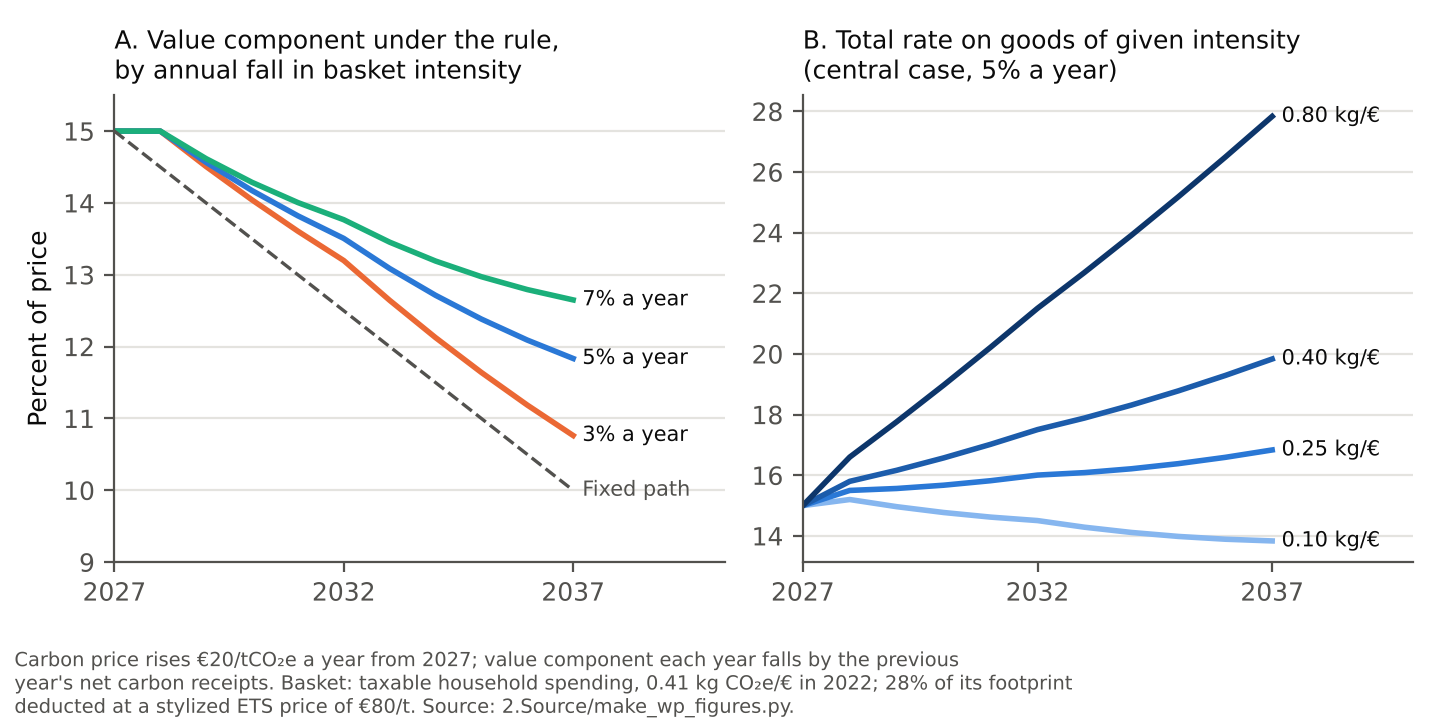
2.Source/make_wp_figures.py.
The 15 percent floor binds. Article 97 of the VAT Directive requires a standard rate of at least 15 percent (Council of the European Union 2006, 2018). A clean good paying 13.8 percent breaches it, and so may the value component itself. The floor should be restated as applying to the sum of the two components on a good at the default intensity of the taxable basket, or the path should start from each member state’s own standard rate, all of which exceed 15 percent: in 2026 they range from 17 percent in Luxembourg to 27 percent in Hungary (Mengden 2026).
Reduced rates and food. The carbon component should apply on top of reduced rates, so that the value component, not an exemption, does any protecting. Directive (EU) 2022/542 already ends reduced rates and exemptions with deduction on fossil fuels by 1 January 2030 (Council of the European Union 2022). Whether the carbon component reaches food is a choice with large stakes: food is 11 percent of household spending, with intensities of 0.42–0.81 kg per euro at purchasers’ prices, so exempting food from the carbon component would remove 27 percent of the carbon embodied in the taxable basket.
7 Distribution
The swap is mildly regressive within member states and, if the value cut were set EU-wide, would move money from poorer member states to richer ones. Setting the cut nationally avoids the second effect; returning the forward obligation’s receipts per household more than offsets the first.
Prior evidence. VAT is regressive against income but proportional or progressive against total spending (Decoster et al. 2010). Household carbon rises with income less than proportionally (Sager 2019; Levinson and O’Brien 2019), so a per-tonne charge takes a larger share of poorer households’ spending before revenue is returned. Feindt et al. (2021), who model a comprehensive consumption-based carbon price in 23 EU countries, find it neutral or progressive within most member states but regressive across the EU, because households in eastern member states bear higher average burdens; small transfers between member states would offset that.
Method. I applied the purchasers’-price intensities of Table 2 to Eurostat’s household budget survey shares by income quintile for the 22 member states with detailed data (Eurostat 2025), at €200 per tonne and 2022 intensities. The direct emissions reached by the forward obligation are allocated by each quintile’s spending on household energy and on fuel for vehicles, using each member state’s emissions from heating and transport (Eurostat 2026a) and its spending on those items (Eurostat 2026c). Each member state cuts its value component to keep the swap neutral. The burden is the full carbon price on every tonne, against no carbon price, so it overstates the change from today by the ETS cost already in prices, and at the central 2037 intensity it would be about half as large. Appendix C lists the simplifications.
2.Source/distribution.py.
| Income quintile | Carbon component (% of spending) | Taxable share of spending (%) | Swap net of national value cut | Obligation (% of spending) | Swap + obligation, returned as VAT cut | Swap + obligation, returned per household |
|---|---|---|---|---|---|---|
| Poorest fifth | 5.53 | 65.5 | +0.41 | 1.59 | +0.50 | −1.16 |
| Second | 5.47 | 66.9 | +0.24 | 1.65 | +0.36 | −0.32 |
| Third | 5.42 | 68.2 | +0.09 | 1.65 | +0.17 | +0.05 |
| Fourth | 5.38 | 69.3 | −0.04 | 1.60 | −0.03 | +0.23 |
| Richest fifth | 5.25 | 70.3 | −0.24 | 1.48 | −0.38 | +0.29 |
Results. The carbon component itself is almost proportional: 5.5 percent of spending for the poorest fifth and 5.3 percent for the richest (Table 4). The swap is regressive for a different reason. Poorer households spend more of their budget on rent, which is exempt, so they receive less of the value-component cut: the taxable share of spending rises from 65.5 percent in the poorest fifth to 70.3 percent in the richest. Net of the national value cut, the poorest fifth pays 0.41 percent of spending more and the richest 0.24 percent less (Figure 3). That spread of 0.65 points is small next to the 5.5 percent of spending that the carbon component reprices. The forward obligation takes about 1.6 percent of spending in every quintile. Returned as a further value cut, it widens the spread slightly; returned as an equal amount per household, it makes the package progressive, with the poorest fifth gaining 1.2 percent of spending and the richest losing 0.3 percent.
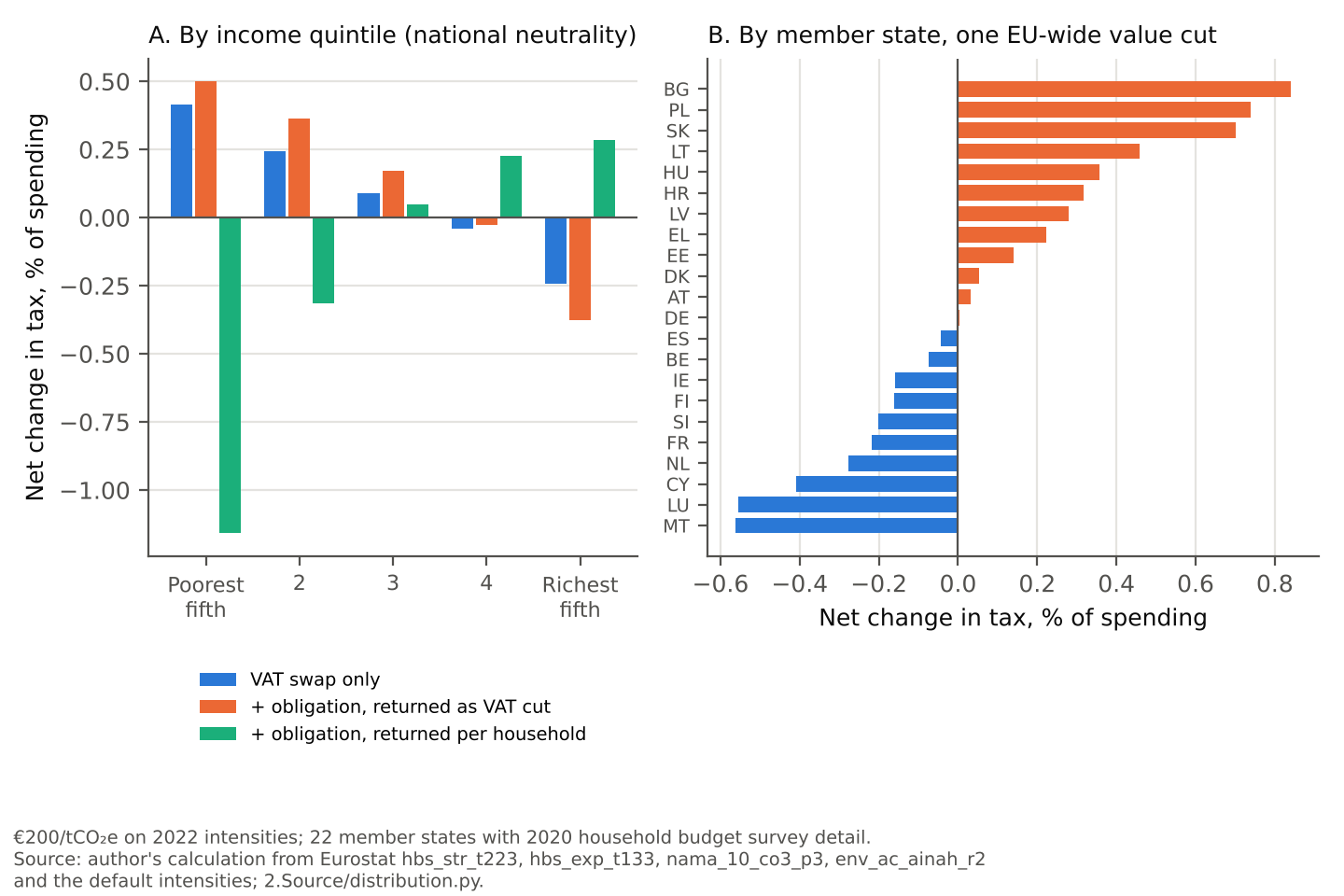
2.Source/make_wp_figures.py.
Between member states. Before any revenue is returned, the carbon component takes 7.0 percent of spending in Poland and 6.7 percent in Bulgaria, against 4.5 percent in Luxembourg. If one EU-wide value cut returned the revenue, Bulgaria, Poland and Slovakia would lose 0.7–0.8 percent of household spending and Luxembourg and Malta would gain 0.6 percent (Figure 3, panel B), the pattern Feindt et al. (2021) find. The neutrality rule avoids this because each member state cuts its own value component by its own receipts. The forward obligation varies more across member states: from 0.7 percent of spending in Finland to 4.0 percent in Croatia and 4.5 percent in Hungary, where household fuel is cheap per tonne of carbon it releases and incomes are lower. The Social Climate Fund, created alongside ETS2 to support vulnerable households (European Parliament and Council 2023), is the natural channel for part of the obligation’s receipts in these member states.
Targeted rebates. Three options follow, in order of preference. Return the forward obligation’s receipts per household or per person, nationally; Table 4 shows this more than offsets the swap’s regressivity. Keep the carbon component on reduced-rate necessities so that the value cut, not an exemption, does the protecting. And present the reform as a cut in VAT on clean goods, because perceived losses drive opposition more than actual ones (Douenne and Fabre 2022; Dechezleprêtre et al. 2025; Carattini et al. 2018).
8 The forward obligation on energy suppliers
Fuel burned in homes and vehicles should be priced through a legal obligation on its suppliers, fixed a decade ahead, because those few firms decide the assets that lock in emissions for decades and a tax reset each budget does not move their investment.
Why VAT cannot reach it. Households emitted 691 Mt CO₂e directly from heating (290 Mt) and transport (401 Mt) in 2022 (Eurostat 2026a). That carbon is released when the fuel is burned, after the last sale, so it is not embodied in any good and the carbon component, which prices embodied carbon, misses it. At €200 per tonne it is worth €138 billion a year, 1.7 percent of household spending. Returned equally, that is €310 a year for each of the 446 million EU residents at the start of 2022 (Eurostat 2026f). Natural gas emits about 0.20 tCO₂ per MWh (Intergovernmental Panel on Climate Change 2006), so the obligation adds €20 per MWh in 2032 and €40 per MWh in 2037; diesel emits about 2.7 kg per liter, on the IPCC factors and an assumed density of 0.84 kg per liter, so €200 per tonne adds €0.54 per liter. A one-person household that burns 12 MWh of gas a year for heating (stylized) would pay about €485 in 2037, more than its equal share of €310; a household that has switched to a heat pump would pay nothing and receive the share.
Market structure. A small number of firms supply these fuels: refiners and fuel importers for road and heating oil, and gas shippers and suppliers for natural gas. They own or contract the refineries, import terminals, pipelines and retail networks, assets that last for decades. Their decisions on refinery conversion, biofuel and hydrogen capacity, and gas network investment fix much of the emissions path to 2050. An obligation that falls on them, not on millions of households, is cheaper to administer and reaches the decision that matters, which is investment.
Time inconsistency. A government that announces a rising carbon tax has an incentive to lower it once firms have invested, so firms discount the announcement (Kydland and Prescott 1977; Helm et al. 2003). The problem is sharper for an oligopoly: a few large suppliers can lobby to delay a price, and each expects that its own underinvestment raises the political cost of enforcing it. Carbon contracts for difference address the same problem for industrial investment (Chiappinelli and Neuhoff 2020). A forward obligation addresses it for fuel supply. Written into law today, naming the price floor and dates a decade out, it is harder to unwind than a tax rate, because firms will have invested on its terms and repeal would be visible and contested, and it becomes a liability on suppliers’ balance sheets now, visible to their auditors and lenders (Brunner et al. 2012; Nemet et al. 2017).
Design. Each supplier surrenders one compliance unit for each tonne of CO₂ in the fuel it releases for final use, with a price floor rising €20 a year to €200 per tonne in 2037, in step with the carbon component. An absolute obligation per tonne sold is stronger than an intensity standard, which implicitly subsidizes fuel use (Holland et al. 2009). The obligation and the carbon component do not overlap for households: the obligation prices the carbon released when the fuel is burned, and the carbon component prices only the carbon emitted in producing and delivering it. They meet where businesses burn covered fuel, in offices, road freight and small industry, whose combustion is embodied in what they sell; there the fuel supplier’s invoice carries the obligation price and Proposition 3 deducts it, so the tonne bears one price. Electricity carries no separate obligation where a carbon component exists (Section 4).
What is new against ETS2 and the Fuel Quality Directive. The EU already has both precedents. The Fuel Quality Directive obliged fuel suppliers to cut the life-cycle greenhouse gas intensity of their fuel by 6 percent by 2020 (European Parliament and Council 2009): an intensity standard, not a price. ETS2 places the compliance obligation on suppliers of fuel for buildings and road transport (European Parliament and Council of the European Union 2023a), the same point of obligation proposed here. Its start was put back from 2027 to 2028 by the 2026 amendment of the European Climate Law (European Parliament and Council of the European Union 2026). Its price-stability mechanism releases 20 million allowances from a reserve when the average price exceeds €45 per tonne, indexed from 2020 prices, for two consecutive months, until the end of 2029 (European Parliament and Council of the European Union 2023a). ETS2 therefore gives firms a quantity path and a soft ceiling, but no floor and no price beyond its first years. The forward obligation adds what ETS2 lacks: a published price floor, rising on a fixed path for ten years, written into the Directive. Technically it is ETS2 with an auction reserve price that rises €20 a year; a floor of this kind is the exogenous price element Goulder and Schein (2013) favor over a pure cap. Three details complete the design. Allowances that do not sell at the floor are cancelled, so the floor is a price, not a promise to buy. Banking is allowed, so suppliers can hedge the published path. And the law may raise the floor but not lower it before 2037 except by a new act, so the commitment binds in one direction. Coverage follows ETS2: fuel released for consumption in buildings, road transport and small industry, whether refined in the EU or imported, which makes the obligation origin-neutral.
Interactions. The obligation’s receipts go to member states, as ETS2 auction revenue does, and should be returned per household (Section 7). The obligation does not alter the carbon component on goods. It interacts with the production track only through fuel switching: as the gas price rises, heat pumps gain and electricity demand grows.
9 Legal basis
The carbon component needs unanimity; the forward obligation does not. This section sets out the stronger reading of each point, the open questions, and the routes that follow.
Article 113 governs a change to VAT. Article 113 TFEU requires the Council, acting unanimously, to adopt provisions harmonizing “turnover taxes, excise duties and other forms of indirect taxation” (European Union 2016). The VAT Directive defines the common system as “a general tax on consumption exactly proportional to the price of the goods and services” (Article 1(2)) and sets the rate structure in Articles 96–99 (Council of the European Union 2006). A carbon component charged on the VAT invoice and credited in the VAT return changes the base, the rate structure and the deduction rules of that Directive. It is an amendment of harmonized turnover-tax law and, on the stronger reading, needs unanimity.
Article 192(2)(a) does not avoid unanimity. Article 192(1) allows environmental measures by qualified majority, but paragraph 2(a) reserves “provisions primarily of a fiscal nature” to the Council acting unanimously (European Union 2016). A component of VAT, collected through VAT returns, is hard to describe as anything other than primarily fiscal. The boundary of “primarily fiscal” is contested: Scuderi (2022) argues for reading it so as to admit environmental levies whose main aim is regulatory, but the Court of Justice has not settled the question, and an argument that a VAT component is not primarily fiscal would be a weak foundation for a measure this size.
The CBAM precedent is contested and does not transfer. CBAM was adopted by qualified majority under Article 192(1) (European Parliament and Council of the European Union 2023b) as a duty to surrender certificates that mirror the ETS, not as a tax. Poland has asked the Court of Justice to annul it on precisely the ground that its provisions are “primarily of a fiscal nature” and needed unanimity under Article 192(2)(a) (Case C-512/23, brought on 8 August 2023) (Court of Justice of the European Union 2023). However the Court rules, a VAT component is further from the ETS model than CBAM is: its price is set by law, not by an allowance market, and it is collected through the tax system. The forward obligation shares CBAM’s structure; the carbon component does not.
Open: national routes under Article 401. Article 401 of the VAT Directive lets a member state maintain or introduce “any taxes, duties or charges which cannot be characterised as turnover taxes”, provided that collecting them does not give rise, in trade between member states, to formalities connected with the crossing of frontiers (Council of the European Union 2006). The Court has identified four essential characteristics of VAT: general application to transactions in goods and services, proportionality to price, charging at each stage of production and distribution, and deduction of tax paid at earlier stages. A national tax that has the essential characteristics of VAT is prohibited, even if not identical to it; one that lacks one of them is not (Court of Justice of the European Union 2006). In Court of Justice of the European Union (1992) the Court struck down a Danish labor-market contribution assessed, like VAT, on sales less purchases. A national carbon component designed as in Section 4 has three of the four characteristics, but not, in its verified form, proportionality to price: it is charged per tonne of embodied carbon, like an excise on carbon content. The design choice therefore matters legally. A charge levied per tonne at verified or per-unit default intensity has a defensible claim to fall outside “turnover tax”; one levied as a per-euro rate on the VAT invoice looks like a second VAT and probably does not. The second condition shapes collection: a national charge on goods bought from other member states would have to be self-assessed in the buyer’s return, as VAT on intra-Community acquisitions is, not collected at a frontier. A member state should seek an opinion on both points before legislating.
Open: the standard-rate floor. A member state acting alone can lower its standard rate to the 15 percent floor of Article 97 and raise the difference through a carbon charge under Article 401. It cannot go below the floor without a unanimous amendment.
Routes. Three follow. Union route: the Commission proposes a Directive under Article 113, offering fiscal neutrality and member-state control of the value component to win unanimity; the passerelle in the last subparagraph of Article 192(2), which lets the Council unanimously move a matter to qualified majority, is not a shortcut, because invoking it needs unanimity too. Coalition route: willing member states legislate national carbon charges under Article 401, designed per tonne, coordinated on defaults and verification. Enhanced cooperation under Article 20 TEU is available, but the financial transaction tax shows its limits: authorized for eleven member states in 2013 (Council of the European Union 2013), it had produced no agreed tax six years later (Council of the European Union 2019). Obligation first: the forward obligation, a compliance scheme like ETS2 and the Fuel Quality Directive, can be adopted now by qualified majority under Article 192(1) as an amendment to the ETS Directive, which ETS2 already is.
Trade law treats the two parts differently. The forward obligation falls on fuel released for consumption, whether refined in the EU or imported, and prices the carbon in the fuel, a physical property of the product, so it raises no like-product question. The carbon component raises the question discussed in Section 5, and a national version raises it in the same form: a member state charging per tonne at defaults the same for every origin treats like products alike, whatever route it takes under EU law.
10 Administration and fraud
The carbon component adds a column to the VAT return, not a new tax administration, but it raises the gain from misdeclaring a product’s category.
What changes for firms. A registered business adds two fields to each invoice, the carbon base and the carbon price already paid, and three to its return: carbon component charged, carbon component credited and net payable. Most firms apply published defaults to their sales by product category, exactly as they apply VAT rates. Importers apply the default at customs clearance, on the customs value, alongside import VAT. Exporters reclaim the component on their inputs. Firms below the VAT registration threshold are outside the system, as for VAT; their purchases carry the carbon component as a cost.
Where it adds little risk. VAT’s credit and refund mechanism already creates particular opportunities for fraud, and the treatment of trade between member states is its weak point (Keen and Smith 2006). The Commission estimates the EU’s VAT compliance gap at €128 billion in 2023, 9.5 percent of liability, and the losses from missing-trader intra-Community fraud at €12.5–32.8 billion a year between 2010 and 2023 (European Commission 2025). A carbon column adds proportionately to the stakes in those frauds, by the carbon component’s share of the tax, but not a new mechanism. Defaults by customs category are checked against the same codes customs already enforce, and the carbon base on an invoice follows from the category and value already declared.
Where it adds real risk. Three points need controls. Misclassification: declaring a product in a lower-intensity category, which the carbon component rewards even where VAT rates are the same. At €200 per tonne, moving a good from a category at 0.60 kg per euro to one at 0.30 saves 6 percent of its value. That is less than the gap of ten points or more between standard and reduced VAT rates, over which classification disputes already arise, but it applies across many more product lines. The remedy is the customs classification system and its penalties, plus defaults that do not vary much within a heading. Rebuttal fraud: overstated claims of low intensity, which carry forward down the chain. Rebuttals should be verified by accredited verifiers under the CBAM rules, audited on a risk basis, and declared at plant or firm level, not per consignment (Neuhoff et al. 2026). Refund positions: where a firm’s output base falls below its input base, Proposition 1 implies a refund. Published defaults should be consistent along chains so that this does not arise from the schedule itself, and refund claims should be checked as VAT refund claims are.
Phasing. Administration favors a slow start: defaults at the EU average, rebuttal open first to CBAM goods where verification exists, and the carbon price starting at €20 a tonne, at which a misclassification gains little.
11 Objections and limits
McLure’s objection: footprinting every invoice costs more than it gains. McLure (2010) argues that a credit-method carbon-added tax needs a carbon footprint on every sale, which is unobservable and costly to estimate, and that an upstream tax on fossil fuels with border adjustments for a few carbon- and trade-intensive basic products does nearly as well for far less. The design here answers part of this. Published defaults by product category move the footprinting from every firm to the Commission, done once a year from input–output data: most firms apply a number as they now apply a VAT rate, and only firms that choose to rebut need footprints. An upstream tax reaches domestic carbon but not the 40 percent of the basket’s carbon emitted abroad, except through border adjustments on every imported product, which need the same default footprints. The rest of the objection stands for the first years: verification is costly, defaults at the level of the Combined Nomenclature do not yet exist, and the gain over an upstream price plus CBAM is concentrated in imported manufactures. That is why the sequence proposed here is the obligation first, a materials charge of the Ismer–Neuhoff kind next (Ismer et al. 2016), and the full carbon component last.
Pricing embodied carbon is not first-best. A tonne embodied in an import is not a tonne added to world emissions if the exporter would have produced it anyway, so taxing all embodied carbon at the full social cost overprices some of it (Jakob et al. 2014). The case here does not rest on optimality. It rests on leakage at the higher prices ahead, on administration (the VAT machinery exists), and on acceptability (a swap, not a new tax). The default schedule’s generosity to imports, about 60 percent of their embodied carbon like for like, partly answers the objection in practice.
Leakage survives through the fuel market. A destination charge stops leakage through the goods channel, but a charge that lowers EU fossil-fuel demand still lowers world fuel prices and raises fuel use elsewhere (Branger and Quirion 2014). No consumption charge avoids that channel; only wider participation does.
Unanimity may never come. The carbon component needs either a unanimous Council or a national design that the Court of Justice has not tested. The paper does not resolve this. It shows that the obligation, which raises more per tonne of household carbon than the carbon component’s first years would, can proceed without either, and that a coalition can start under Article 401 if it designs the charge per tonne.
The calibration is coarse. The 23 categories average over products with very different footprints, the 2020 household survey is combined with 2022 intensities, and the burden in Table 4 counts the full carbon price on every tonne. The results are orders of magnitude for design, not a legislated schedule.
12 Conclusion
A carbon component credited through the VAT chain charges each firm on the carbon it adds and the consumer on the carbon in the whole supply chain, as VAT does for value. Calibrated on Eurostat’s input–output tables, the taxable household basket embodies 0.41 kg CO₂e per euro and imports from outside the EU about 1.7 times as much per euro as the same goods made inside it, so the carbon component reaches the 40 percent of the basket’s carbon emitted abroad that the ETS and CBAM do not. A rule that cuts the value component by last year’s carbon receipts keeps the swap neutral without a forecast, and setting it nationally avoids transfers between member states. The swap is mildly regressive, and returning the forward obligation’s receipts per household more than offsets it. The main limitation is legal: the carbon component needs unanimity, or a national design per tonne that the Court has not tested. The next steps are a legal opinion on that design, a default schedule at Combined Nomenclature level, and the forward obligation as an amendment to ETS2 with a price floor to 2037.
Downloads
References
13 Appendix A: Literature review
This appendix reviews the literature by theme. Where only an abstract or the bibliographic record could be checked, the text says what a work addresses rather than what it finds.
A.1 Destination and origin bases, and VAT. VAT is levied on the destination basis: the tax on a good or service accrues where it is consumed, with exports relieved and imports charged (OECD 2017). The equivalence of origin- and destination-based commodity taxes is old: for a uniform, broad-based tax, switching the basis changes price levels and exchange rates but not real allocations (Lockwood et al. 1994). Lockwood and Whalley (2010) apply the result to carbon border adjustments and argue that the policy debate confuses price-level effects with relative-price effects. The result cuts both ways for this paper. It explains why the VAT machinery adjusts for borders without extra apparatus, which is the practical case for using it. It also shows that VAT’s value component, being uniform, carries no carbon incentive and no trade advantage: everything that matters for carbon and for trade sits in the carbon component. The World Bank’s total carbon price takes the same view: Agnolucci et al. (2024) compute direct and indirect carbon prices for 142 countries over 1991–2021 and exclude general VAT because, as across-the-board consumption taxes, VATs “do not affect relative prices”; only VAT preferences on fuels enter, as subsidies. The arithmetic that a 15 percent VAT on a good embodying 0.30 kg per euro is “worth” €500 per tonne is correct, but it is not a carbon price in any useful sense.
VAT’s spread is documented by Keen and Lockwood (2010). Destination-based business taxation rests on the same logic as VAT: a tax levied where the immobile consumer is removes the incentive to shift profits or production (Auerbach et al. 2017). Shapiro (2021) adds an observation that sharpens the case for a destination charge on carbon: tariffs and non-tariff barriers are lower on dirty industries than on clean ones, which amounts to an implicit global subsidy to CO₂ in traded goods of $550–800 billion a year. The existing destination-side tax on trade already prices embodied carbon negatively.
A.2 Consumption-based accounting. Production-based inventories, which national targets use, attribute emissions to the country where they occur; consumption-based accounts attribute them to the country of final demand (Peters and Hertwich 2008). Emissions from producing traded goods grew from 4.3 GtCO₂ (20 percent of the global total) in 1990 to 7.8 GtCO₂ (26 percent) in 2008, and net transfers from developing to developed countries grew from 0.4 to 1.6 GtCO₂, more than the Kyoto Protocol’s reductions (Peters et al. 2011). In 2004, 23 percent of global CO₂ was embodied in trade, and more than 30 percent of consumption-based emissions were imported in Switzerland, Sweden, Austria, the United Kingdom and France (Davis and Caldeira 2010). Grubb et al. (2022) find that net transfers peaked around 2006 and have declined since.
Two qualifications matter. Jakob et al. (2014) argue that a tonne of imported embodied emissions is not a tonne added to global emissions, so pricing all embodied carbon at the full social cost is not first-best; trade measures should concentrate on a few emissions-intensive, highly traded industries. And Steininger et al. (2014) compare the justice and cost-effectiveness of consumption- and production-based approaches for a region acting alone. This paper therefore rests the case for a consumption charge on leakage, administration and acceptability, not on first-best optimality (Section 11).
A.3 Carbon-added taxes, footprint taxes and consumption charges. The carbon-added tax was proposed for Canada by Courchene and Allan (2008): a destination-based tax that, like a VAT, rebates the carbon tax on inputs so that only the carbon added at each stage is carried forward, with imports taxed at entry and exports relieved (Courchene and Allan 2011). McLure (2010) replied that carbon content is unobservable, that extending a credit-method tax through retail would impose compliance and administrative costs out of proportion to the gain, and that border adjustments on imports would need the same ad hoc methods as other carbon taxes; he preferred an upstream tax with border adjustments limited to a few carbon- and trade-intensive basic products. McAusland and Najjar (2015) analyze a carbon footprint tax modeled on a credit-method VAT. They find a pure version, which requires the footprint of every product, possibly too costly, and propose a hybrid in which firms either calculate their own footprints or use default footprints for their product class; because it falls on all goods consumed at home, it keeps domestic firms on an equal footing with producers in countries without climate policy. Eichner and Pethig (2015) show that a unilateral consumption-based carbon tax can produce negative leakage in general equilibrium.
A European proposal for a consumption charge on carbon-intensive materials, sometimes called a climate contribution, is the nearest policy relative. Ismer et al. (2016) set out its legal design as an excise-like charge at product-specific benchmark intensity, applying equally to imports. Pollitt et al. (2020) simulate it with the E3ME model: with the charge rising to about €80 per tonne by 2050, it cuts EU CO₂ emissions by up to 10 percent by 2050 and, because imports are charged alike, avoids leakage. Grubb et al. (2022) place the charge among three trade-compatible price options (border adjustments, a carbon-footprint consumption charge, and an excise contribution combined with free allocation). They note that a charge on actual footprints would reward exporters who decarbonize, but that tracing embodied carbon through global value chains is administratively demanding and open to fraud; defaults by product category are a feasible shortcut if they apply to imports and domestic goods alike. Neuhoff et al. (2026) restate the idea for the CBAM era: CBAM’s production-specific intensities invite resource shuffling, as foreign producers send their cleanest output to the EU; they propose a standardized liability per tonne of material, independent of process and origin, applied along the value chain with export relief.
Holland (2012) shows that, when regulation is incomplete and leakage is possible, an intensity standard combined with a consumption tax can sometimes reach the first best, and Böhringer et al. (2017) that output-based rebating combined with a consumption tax on emission-intensive, trade-exposed goods can be equivalent to a border carbon adjustment: the formal case for pairing the consumption track with an intensity-based production track. What this paper adds to the line is the chain results, the calibration for a whole household basket, the swap inside VAT, and the deduction that links the consumption track to the production track.
A.4 Border adjustment, trade law and trading partners. The design literature establishes the main choices for border carbon adjustment: sectoral coverage, the measure of embodied carbon (domestic benchmark, country default or firm data), treatment of exports, and recognition of foreign policy (Ismer and Neuhoff 2007; Mehling et al. 2019; Keen et al. 2022). Mehling et al. (2019) give the fullest legal analysis, under GATT Articles I, II:2(a), III and XX and the Agreement on Subsidies and Countervailing Measures, and recommend narrow coverage, default values with a right of rebuttal and crediting of foreign policies; they leave open whether carbon intensity can differentiate like products under Article III:2. Ismer and Neuhoff (2007) argue that border adjustment at the intensity of the best available technology is defensible. Keen et al. (2022) recommend benchmarking first on domestic intensities and moving to country-specific values later, with rebuttal, and note the tension between destination-basis border adjustment and the origin-basis accounting of the Paris Agreement.
The evidence on trading partners favors one default for every origin. Mattoo et al. (2009) find that a border tax on the carbon content of imports, measured at the exporter’s own intensity across all merchandise, would cut China’s manufacturing exports by about a fifth and low- and middle-income countries’ exports by 8 percent, while a tax based on the carbon content of domestic production would do far less damage. Maliszewska et al. (2025) find macroeconomic exposure to CBAM small for most countries and high for a few; their method could size partners’ exposure to an economy-wide carbon component. Evans et al. (2021) show that a border adjustment on imports alone leaves exporters exposed and that export relief raises legal risk, which careful design can reduce; a VAT-based charge zero-rates exports by construction.
A.5 Leakage. Model-based studies find leakage of 5–25 percent without border adjustment, and some leakage survives border adjustment through the fossil-fuel price channel (Branger and Quirion 2014). Ex-post studies find no detectable leakage from the EU ETS so far (Naegele and Zaklan 2019; Dechezleprêtre et al. 2022), partly because industry was shielded by free allocation (Grubb et al. 2022). Two consequences follow. The claim that a destination charge is leakage-proof holds for the goods channel only. And the case for a consumption charge concerns the carbon prices of €100–200 per tonne in prospect, not the leakage observed at the prices of the past.
A.6 Distribution and acceptability. Household carbon is a necessity. Environmental Engel curves for the United States show household CO₂ rising with income but less than proportionally (Sager 2019), and the same holds for local air pollutants, with curves shifting down over time (Levinson and O’Brien 2019). A uniform per-tonne charge on consumption therefore takes a larger share of poorer households’ spending before revenue is returned. VAT itself is regressive against income but proportional or progressive against total spending (Decoster et al. 2010). The most directly relevant study is Feindt et al. (2021), who model a comprehensive carbon price on all goods, including imported ones, in 23 EU countries: incidence before recycling is mostly neutral, sometimes progressive, within countries, but regressive across the EU, because households in lower-income, mainly eastern, member states bear higher average burdens; relatively small transfers between member states would offset this. Section 7 reproduces both patterns with independent data.
Acceptability depends on perceptions as much as on incidence. After the Yellow Vests protests, most French respondents rejected a tax-and-dividend scheme, overestimated their own losses and wrongly believed it regressive, and information moved beliefs only slightly (Douenne and Fabre 2022). Across 20 countries, support for climate policies depends on perceived effectiveness, perceived personal losses and concern for poorer households (Dechezleprêtre et al. 2025). Carattini et al. (2018) identify five sources of resistance to carbon taxes (personal cost, regressivity, economic damage, doubts about effectiveness and suspicion of a revenue grab) and remedies including phasing, earmarking, lump-sum rebates and communication; Klenert et al. (2018) review how revenue use shapes public support. A revenue-neutral swap phased over ten years answers the revenue-grab and personal-cost concerns; presenting it as a cut in VAT on clean goods answers the effectiveness concern.
A.7 Credibility and forward commitment. Optimal plans are time-inconsistent when agents’ expectations depend on future policy (Kydland and Prescott 1977). Helm et al. (2003) apply the problem to carbon and propose delegating carbon policy to an independent agency; Brunner et al. (2012) compare commitment devices, including legislation, delegation, contracts and reputation; Nemet et al. (2017) set out remedies for credibility problems in low-carbon investment and their advantages and drawbacks. Chiappinelli and Neuhoff (2020) show that carbon contracts for difference, in which the government pays investors a fixed carbon price, improve decarbonization incentives and derive conditions under which the government is willing to tie its hands. On instrument choice, exogenous pricing through a tax or a cap with a price floor or ceiling avoids price volatility and harmful interactions with other policies (Goulder and Schein 2013). The forward obligation of Section 8 applies these ideas to ETS2: it is an application, not a new mechanism, and its novelty is the published floor fixed a decade ahead.
A.8 Feebates and the production track. Feebates price intensity without raising average costs. Sterner and Höglund Isaksson (2006) analyze Sweden’s refunded NOₓ charge, a working revenue-neutral feebate, and D’Haultfœuille et al. (2014) find that France’s car bonus-malus shifted purchases toward low-CO₂ cars but raised total CO₂ emissions, because it also raised car sales: a lesson on benchmark design. Intensity standards, the regulatory cousin of feebates, implicitly subsidize output and can even raise emissions (Holland et al. 2009); the consumption track exists to supply the output margin they miss (Stretton 2026d, 2026b).
14 Appendix B: Proofs
Setup. Stages \(k = 1, \dots, n\); \(p_k = p_{k-1} + w_k\) with \(p_0 = 0\); \(E_k = \sum_{j=1}^{k} a_j\) with \(E_0 = 0\); carbon base \(C_k\) with \(C_0 = 0\); remittance \(T_k\) as in equation 1. Prices are cost plus value added; taxes are passed to the next stage, except that an exempt firm’s irrecoverable input taxes become part of its price.
Proposition 1. (i) \(\sum_{k=1}^{n} T_k = v \sum_{k=1}^{n} (p_k - p_{k-1}) + P \sum_{k=1}^{n} (C_k - C_{k-1}) = v\,p_n + P\,C_n\), because both sums telescope; nothing depends on \(C_1, \dots, C_{n-1}\). (ii) With \(C_k = E_k\), the carbon part of \(T_k\) is \(P(E_k - E_{k-1}) = P\,a_k\). (iii) The consumer pays \(p_n + v\,p_n + P\,C_n\); with \(C_n = E_n\) the carbon part is \(P\,E_n\). Under carry-forward, \(C_k = C_{k-1} + a_k\) for every \(k\) from the first verified stage on, so a verified base upstream reaches \(C_n\) and hence the consumer price.
Proposition 2. Let stage \(j\) be exempt. It remits nothing and pays \(v\,p_{j-1} + P\,C_{j-1}\) to its supplier without credit, so its price is \(p^x_j = p_{j-1} + w_j + v\,p_{j-1} + P\,E_{j-1}\) when \(C_{j-1} = E_{j-1}\). (i) If \(j = n\), the consumer pays \(p^x_n = p_n + v\,p_{n-1} + P\,E_{n-1}\) and no further tax. Against full crediting, \((1+v)\,p_n + P\,E_n\), the difference is \(-v\,w_n - P\,a_n\): value added and carbon added at the exempt stage go untaxed, and upstream carbon is charged once. (ii) If \(j < n\), every later price is higher by \(\Delta = v\,p_{j-1} + P\,E_{j-1}\), and stage \(j+1\) has no creditable input tax, so the taxes on later invoices are \(v\) and \(P\,C_k\) on the full values and bases. The consumer pays \((1+v)(p_n + \Delta) + P\,E_n\), which exceeds the full-crediting outlay by \((1+v)\,\Delta = (1+v)(v\,p_{j-1} + P\,E_{j-1})\). The upstream carbon \(E_{j-1}\) is charged once inside \(\Delta\) and again inside \(E_n\).
Proposition 3. With \(Q_k = \sum_{j=1}^{k} \min(q_j, P)\, a_j\) and carbon component \(P\,E_k - Q_k\) on each sale, firm \(k\) remits \((P\,E_k - Q_k) - (P\,E_{k-1} - Q_{k-1}) = (P - \min(q_k, P))\,a_k \ge 0\). Each tonne emitted at stage \(k\) bears \(q_k\) directly and \(P - \min(q_k, P)\) through the carbon component, a total of \(\max(P, q_k)\). Summed over the chain, the carbon component raises \(P\,E_n - Q_n\) and explicit prices raise \(\sum_{k=1}^{n} q_k a_k\), which equals \(P\,E_n\) when every \(q_k \le P\). For a revenue-neutral feebate the sector-average net price is zero, so it contributes nothing to \(Q\) and the consumer bears \(P\,E_n\) through the carbon component. With default bases \(C_k\) in place of \(E_k\), \(P\,C_k - Q_k\) can be negative when the default understates an ETS-heavy chain; flooring the charge at zero keeps every remittance from becoming a refund on that account.
All three results were checked symbolically for \(n = 4\) with sympy, and the worked example of Section 4 numerically, in 2.Source/check_propositions.py.
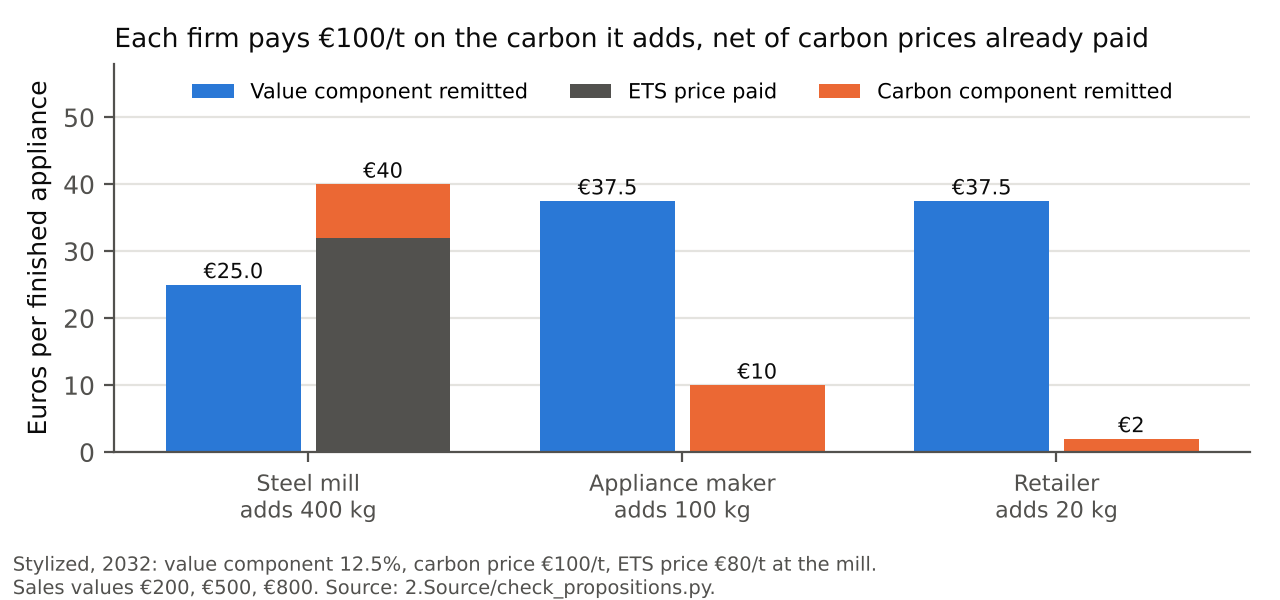
2.Source/make_wp_figures.py.
15 Appendix C: Calibration of defaults and distribution
Data. (1) FIGARO inter-country input–output table at basic prices, product by product, 2022, million euro (Eurostat 2026b): 50 economies (45 named countries plus the rest of the world and four Western Balkan economies) by 64 CPA products, with five categories of final demand. (2) Greenhouse gas emissions by emitting country and NACE A*64 industry, thousand tonnes CO₂e, from the footprint dataset with destination “world” and all final demand (Eurostat 2026d); the CO₂-only dataset gives the last column of Table 2. (3) Household direct emissions from heating and transport (Eurostat 2026a). (4) Household budget shares by income quintile, 2020 wave, and mean expenditure by quintile (Eurostat 2025). (5) Household final consumption by COICOP purpose, 2022 (Eurostat 2026c). All were downloaded from the Eurostat API on 29 October 2026.
Model. With intermediate flows \(Z\), output \(x\) and technical coefficients \(A = Z \hat{x}^{-1}\), emission intensities per euro of output \(s = f \hat{x}^{-1}\), where industry emissions \(f\) are assigned to the matching CPA product, the multipliers are \(m = s\,(I - A)^{-1}\), in kg CO₂e per euro of final demand. The four Western Balkan economies, present in FIGARO but not in the emissions data, take the rest-of-world intensity for each product; they are a negligible share of EU purchases. Category intensities weight \(m\) by EU-27 household final consumption by origin and product. The model gives an EU-27 footprint of 3,749 Mt CO₂e for all final demand excluding households’ direct emissions, against Eurostat’s 3,743 Mt; for households alone, 2,282 Mt against 2,255 Mt; for CO₂ alone, 2,760 Mt against 2,797 Mt.
Purchasers’ prices. Household purchases of trade services (CPA G45–G47), €1.19 trillion, are 64.5 percent of household purchases of goods (CPA A–C) at basic prices, €1.85 trillion. Spreading them evenly gives a goods intensity at purchasers’ prices of \((e_g + 0.645\, e_{\text{trade}})/1.645\). Taxes on products are excluded throughout.
Sources of the footprint. Of the 2,116 Mt CO₂e embodied in taxable household purchases, 28 percent was emitted by EU power and energy-intensive industry (CPA D35, C17, C19, C20, C23, C24, a proxy for ETS coverage), 14 percent by EU agriculture, 17 percent by other EU industries and services, and 40 percent outside the EU (2.Source/footprint_sources.csv).
Distribution. COICOP 3-digit purposes are mapped to the categories of Table 2 (2.Source/distribution.py); rents, health and education services, social protection, insurance and finance are exempt. Household energy (COICOP 04.5) carries the embodied intensity of electricity and gas supply per euro of EU spending on it, 0.83 kg CO₂e per euro; fuel for vehicles (07.2) carries the supply-chain intensity of refined petroleum products per euro of spending on it, 0.25 kg per euro. Direct emissions per euro of 04.5 and 07.2 spending are computed for each member state. Simplifications: budget shares are applied to spending including taxes; every member state uses EU-wide defaults; national quintiles are averaged with household-spending weights rather than ranked EU-wide; the 2020 survey wave is combined with 2022 intensities.
Code. 2.Source/calibrate_defaults.py builds the model and writes defaults_by_category.csv, defaults_by_product.csv, basket_summary.csv and footprint_sources.csv; 2.Source/distribution.py writes the distribution files; 2.Source/make_wp_figures.py prints the fiscal numbers and draws Figure 1, Figure 2, Figure 3 and Figure 4. The input–output download is about 72 MB and is cached outside the repository. Setting the environment variable CCT_YEAR=2023 reruns the calibration for 2023, which gives a taxable basket intensity of 0.36 kg CO₂e per euro.